
Adam Herbert, CEO and Co-Founder, Go Live Data
Adam Herbert on building intent-driven B2B marketing, why frequency rules matter more than volume, and the shift from AI experimentation to accountability.
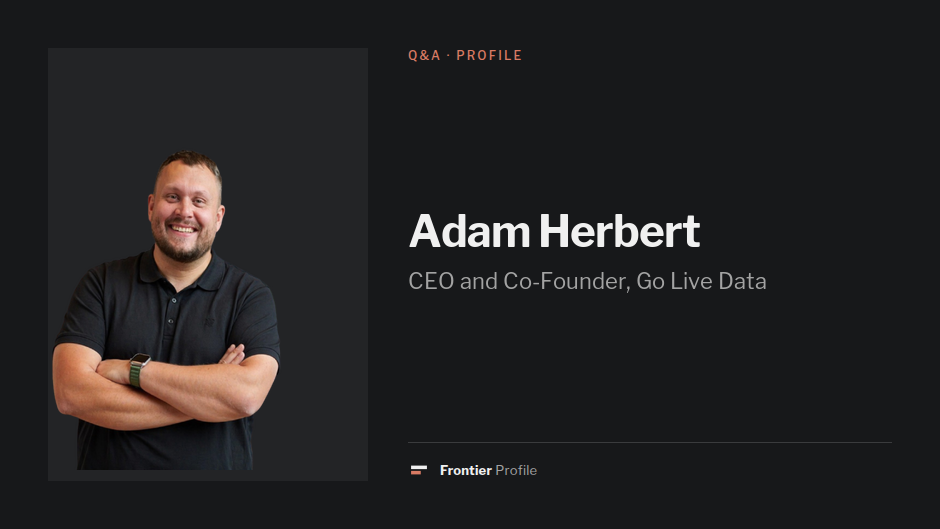
Adam Herbert is CEO and Co-Founder of Go Live Data, a Manchester-based marketing technology company that connects B2B organisations with the right prospects at the right time. With over 25 years in the data and outreach industry, Adam co-founded the business in 2019 alongside CTO Tim Langley, building it from a garden shed into a team of over twenty. Go Live Data owns its entire stack - from a B2B database of more than 100 million business records refreshed every 30 days, to its own email engine, intent tracking and creative services. What sets the company apart is its insistence on quality over volume: frequency rules are written into client contracts, opportunities are only passed when there's genuine intent, and around 80 per cent of outreach is educational rather than sales-focused. In this interview, Adam explains why the industry had stagnated, how AI helps businesses decide where to put their attention, and why he recently walked away from a major contract rather than compromise on responsible engagement.
My questions are in bold - over to you Adam:
Who are you and what's your background?
I'm Adam Herbert, co-founder and CEO of Go Live Data. We're a Manchester business, based in the Northern Quarter, and I run it with my co-founder and CTO, Tim Langley.
I've spent more than 25 years in B2B data and outreach, and I started at the bottom. My first job in the industry was on the phones, in telesales at LBM Direct Marketing in 1998. From there I went into field sales, then European sales and marketing, then key accounts, and back to LBM as a business development manager. In 2010 I joined Market Location, one of the UK's biggest B2B data providers at the time and spent the best part of a decade there as account director, business development director and digital director, and finally head of business development.
Along the way I worked with some of the biggest names in the market, helped build the data behind the alternative lending and fintech sector as it took off, and guided some very large businesses through GDPR compliance and the job of keeping a database clean once the rules changed.
What bothered me the whole time was the gap between the amount of information a business could get hold of and how little of it helped anyone make a better decision. The industry had stagnated. Data was bought once, went stale, and was used to contact people who had no reason to be interested. I could see so many ways to do it better, but you cannot fix that from inside a business that sells the old way.
Then I had a chance meeting with Tim. He had the technical skills to build what I could see commercially. We started Go Live Data in 2019 in a garden shed and launched properly in 2020. Our first Manchester office came in 2021 and we moved into our city centre headquarters last year.
Tim builds the technology. I work out how it makes money for a customer. I'm not interested in AI for its own sake. I'm interested in what it lets a business do better.
What is your job title and what are your general responsibilities?
I'm CEO, which in a business of our size means I'm involved in everything from strategy and product to customers, partnerships and the odd problem nobody else wants.
My main job is setting direction and making sure what we build solves a real commercial problem for the people paying for it.
I work closely with Tim and the wider team on the technology, particularly how we use data and intent signals to make outbound marketing more effective. One thing we introduced at launch and have stuck to ever since is what we call Frequency Rules. Every campaign is paced. Nobody gets hammered. Around 80 per cent of what we send is educational rather than a sales pitch. And the rules on how often a business is contacted, when a conversation gets passed to a client and what happens afterwards are written into our client contracts. That was not normal in our industry in 2020 and it still isn't, and we recently lost a huge contract due to the client not agreeing with our frequency rules and wanting to communicate more often, which is something we won't do due to the mission we are on, even though losing revenue in these situations does hurt.
I'm also hands on with customer relationships, business development and finding the next opportunity for growth.
As a founder you're always balancing what you're building for next year with what the business has to deliver this week. The technology moves fast. Customers still expect you to deliver every month, and they're right to.
Can you give us an overview of your business?
Go Live Data is a privately owned, self-funded UK marketing technology company. We launched in 2020 and have grown into a team of over twenty.
Put simply, we connect businesses that could work together. We help B2B organisations find the companies that should be their customers, reach them with the right message, and know when the timing is right.
The way we do it is a blend. AI and our own technology do the heavy lifting: keeping the data current, spotting the intent, deciding what should happen next. People do the parts that need judgement: the creative, the conversation with the client, the qualification of an opportunity before it goes anywhere. Our line has always been high tech solutions, powered by humans, and we mean it. Neither half works properly without the other.
The old approach to outbound marketing was volume. Build a big list, send a lot of messages, hope enough people reply. We think that is both ineffective and unnecessary.
What makes us different is that we own everything we use. Our own B2B database, covering the UK, Ireland, USA and Canada, with more than 100 million business records globally refreshed on a rolling 30 day cycle. Our own email engine. Our own site tracking and intent technology. Our own creative. Nothing is rented from someone else and re-sold.
Those pieces have names. Go Data is the database. Go Email is the outbound engine. Go Track identifies the businesses showing buying intent on a client's website. Go Create is the creative that goes with it.
The way it works is simple. Email is the engine that starts the conversation. The intent layer then decides what happens next: a remarketing message, a direct mail piece, a social touch, or a verified opportunity passed straight to the client's sales team. The channel follows the intent, not the other way round.
We work with clients across energy, business finance, insurance, fleet and automotive, education and hospitality, from fast growing SMEs to household names and some of the largest companies in the world, and several of those relationships are now multi year with some now spanning the last 6 years.
We were ranked 31st in TechRound's list of UK tech firms and 44th in the Elite Business Top 100 in 2026, and we pride ourselves on the quality of customer service from the first conversation onwards.
What problem do you solve with AI?
B2B sales and marketing teams waste an enormous amount of time and money contacting the wrong people.
Sometimes the data is wrong. Sometimes it is out of date. Sometimes the person has no reason to be interested. All three happen every day in every sales team in the country.
AI lets us attack that at a scale and speed that would be impossible by hand.
Keeping millions of business records accurate means continuous monitoring, updating and validation. Technology spots the changes, the inconsistencies and the patterns far faster than a person can.
Intent adds a second layer. Rather than asking whether a business fits the profile, we can see signals that it is actively looking at a relevant product or service right now.
That changes the question from "who could buy this?" to "who has a reason to talk to us this week?"
For our customers it means more relevant outreach, better prioritisation and a lot less wasted effort.
I'd stress one thing. AI does not turn every signal into a sale. It helps a business decide where to put its attention. The selling is still done by people, and so is the judgement about which opportunity is worth a call. That is deliberate. We built the business as a blend of technology and humans, because that is the combination that gets results.
What does the AI actually do, and how is it built?
Two things. Keep business information accurate, and interpret the signals that point to demand.
Take a company selling a service to finance directors. The traditional route is to buy a list of businesses that match some criteria and start calling. The problem is that some of the records are already out of date, and there is no evidence that any of those businesses have a current need.
Our approach puts the business data and the intent intelligence together. The data engine keeps the records current on a rolling 30 day cycle. Go Track then watches what happens when a business engages: which pages it looks at, whether it comes back, whether it moves from one page to another. A single page visit does not count as an opportunity. We want to see behaviour, not a click.
The commercial value is in the combination. Accurate data gets you to the right organisation. Intent tells you when to go.
We are also clear that a signal is not a purchase decision. We pass a client a verified contact who was on their site, or the senior decision maker we have mapped to that business, and a human qualifies it from there.
On the architecture, the models, the infrastructure and the development choices, that is Tim's domain as CTO. He is a Cambridge mathematician who still writes code and reviews the architecture himself, and he would be the right person to go deep on it.
Who are your target customers, and what's your revenue model?
Our customers are B2B organisations that need to find new business and reach decision makers more effectively.
Typically they operate in competitive markets where acquiring a customer is expensive and timing changes the outcome. Energy, business finance, insurance and fleet are good examples.
The businesses that get the most from us have three things: a clearly defined audience, a strong proposition and a sales team that will act on an opportunity quickly.
Better data will not rescue a poor product or a broken sales process. But if the proposition is good, we can make the outreach sharper and better timed.
Commercially, we sell data, intelligence and campaign delivery. The shape of the deal depends on the client. Some pay per opportunity delivered, some pay a fixed monthly retainer, and some combine the two. Larger clients tend to want the full programme, with email, tracking and the opportunities flowing into their team each week.
What we do not do is encourage a client to buy a bigger database. The point is better commercial outcomes, not more records.
What's the evidence it works, and what have you learned along the way?
The biggest lesson is that more activity does not mean better results.
Businesses get obsessed with how many emails went out, how many contacts they hold, how busy the sales team looks. None of that means anything if it is not turning into commercial outcomes.
So we have moved further and further towards quality of data, relevance of audience and timing of the approach.
Here is an example of what that looks like in practice. A major UK business finance provider came to us because the wider data market could not solve a specific problem for them. They needed to reach businesses at their trading address, not the registered office that sits on Companies House. When they assessed other data suppliers, none could give them more than 10,000 unique mailing addresses. In one recent month we identified 450,000 unique trading address locations across 350,000 companies, matched against their own records. That programme has grown year on year because the data does something nobody else could do.
The second lesson is about growing too fast.
We looked at international expansion before we were ready to support it operationally. The opportunity was real, but we underestimated what it takes in infrastructure, people and process to deliver properly in a new market. So we pulled back and did it the slow way: a full year of testing in the US through partnerships in hospitality and finance before we sold anything there. Seeing an opportunity and being ready for it are two different things.
That lesson applies to AI as much as anything else. Businesses get so focused on what the technology makes possible that they skip the question of whether they are ready to use it. The results come when the technology, the people and the process line up.
How do you handle the data question?
Data quality and responsible use are the whole business. If we get that wrong there is no business.
We work with business information only. We send to business email addresses, under legitimate interest, and the data is refreshed every 30 days so it stays current. We are ICO registered, a member of the DMA, and we completed the ICO's Data Protection Essentials this year.
Where we have been most vocal is on frequency. Just because the technology lets you contact more people, more often, does not mean you should. So we wrote the rules into our contracts. An opportunity is only passed to a client when there is positive intent. Once it is passed, we do not email that business again for six months. The client's contact is capped at eight attempts in four weeks, and we seed our own records into every file so we can police that cap. Every campaign carries one click unsubscribe.
Our own marketing runs on one email a month unless the recipient engages, and never more than two.
AI adds responsibility rather than removing it. A business needs to know how information is being processed, which systems can touch it and what the controls are.
And transparency matters. An enterprise client should be able to ask hard questions about where the data came from, how it is processed, how it is secured and who is accountable, and get a clear answer. We welcome those questions because we can answer them.
What's new at the company, and what's coming next?
The focus is intelligence that helps businesses move away from volume and towards relevant, well timed engagement.
The opportunity is not to process more data. It is to understand the data better and turn it into something a sales team can act on the same day.
The next stage for our industry is moving beyond identifying potential customers to deciding which opportunities actually deserve attention, and how and when to engage them. That is where we are putting the development effort.
A few specific things are in progress.
Timing is the big one. When a business shows intent, the value of that moment decays fast. We are working on getting an opportunity in front of a client, and in some cases a call made, within the hour, while the intent is still live. That includes testing AI assisted calling alongside human teams.
We are building self serve tools so a client can run their own counts against our data in seconds rather than waiting for us, starting with our fleet and automotive file. And we are developing a readiness product that scores a business on how prepared it is before anyone approaches it.
Internationally, the US is now live with our email, tracking and creative products after that year of testing, and that is where a lot of our next growth will come from.
None of this is about releasing features because they are fashionable. Everything has to solve a problem a customer is paying us to solve.
If you had a magic wand, what one thing would you change about how AI gets bought and deployed?
I'd stop businesses buying AI because they are frightened of being left behind.
There is huge pressure to show the board you are investing in AI, so the conversation starts with the technology instead of the problem. That is the wrong way round.
Start with what isn't working. Where is time being wasted? Where is money being wasted? What would a better outcome look like? Then ask whether AI gets you there.
In our world, sending more emails is not the objective. Creating better commercial opportunities is.
If AI does that, fantastic. If it just lets you do more of something that was not working in the first place, what is the point?
What's your message for large enterprises evaluating AI right now?
Start with the commercial problem and work backwards.
Ignore the impressive demo. Ask what it will deliver for your organisation, how success will be measured and what safeguards are needed.
Then look very hard at the data. You can spend millions on technology, but if the information underneath it is wrong, incomplete or poorly understood, the output will be too. We see this every week. The model is rarely the problem. The data going into it is.
Do not underestimate people. AI should make decisions faster and better. It should not remove human judgement or accountability.
My advice: one clearly defined use case, proper performance measures, test it hard, and scale once it has proved itself.
Can you list three people you rate from the AI sector that we should be following on LinkedIn, and why?
1. Piers Linney, Executive Chairman and co-founder, Implement AI
Piers has run businesses, sat on the other side of the table as an investor, and is now building AI agents that do real work inside real companies rather than demos. He talks about AI adoption from the point of view of the business owner, which is rare, and he is blunt about what does and does not work. I rate people who have had to make payroll and are now applying AI to the problems they actually had.
2. Anton Osika, co-founder and CEO, Lovable
Lovable has changed what a business our size can build without a development team, and Anton is very open about how the company is growing and what they are learning. His posts are a useful window into how fast the tooling is moving and what that means for anyone who has ideas but no engineers to hand.
3. Elon Musk, founder of xAI
You don't have to agree with everything he says or does to recognise what he's doing. He constantly challenges what is accepted as possible, and the scale of ambition behind xAI and Grok is hard to ignore. As a founder, the lesson is in the willingness to question how an industry works and whether technology can do it differently.
What AI tools do you personally use day to day?
The useful ones are the ones that become part of the working day rather than asking you to change everything.
For me, that means three.
Claude (claude.ai) is where most of my thinking and writing now starts. Research, analysing campaign data, drafting proposals and client reviews, building internal strategy documents, and increasingly running multi step pieces of work while I am doing something else.
Lovable (lovable.dev) lets me build working software without a development team. I have used it to build internal tools for the business, including a self serve count engine for our data, and client facing sites with AI assistants built in. A year ago those would have been projects for a developer. Now they are an afternoon.
Fireflies (fireflies.ai) sits in every meeting and gives me the summary and the actions. I don't take notes any more.
And of course our own technology, which is how we work with business data and intent every day.
What I am careful about is confusing using a tool with trusting everything it produces. AI gives me a starting point. I still want to understand the information and apply my own judgement before I make a commercial decision.
What's the best new AI product or service you've seen recently?
The shift that has impressed me most is from AI that answers questions to AI that does the work.
The specific product is Lovable. I evaluated it properly this year and then used it to build real tools for the business. The reason it impressed me is simple: I described what I wanted, and within hours I had something I could put in front of a customer. It changed my view of what a business our size can build.
The same principle is now showing up in the AI assistants themselves, which can run a sequence of tasks rather than return a single answer. That is where business productivity is going to move.
The caveat is the same as always. The output has to be reliable, the process has to be understood and someone has to be accountable. The technology I am most interested in is the kind that takes the admin away so people can spend their time on decisions, relationships and opportunities.
Finally, what trends do you think will define AI over the next year or so?
A shift from experimentation to accountability.
Businesses have spent two years finding out what AI can do. The next question is whether it is delivering a return, and the answer will not always be yes.
Five things I expect to matter.
First, measurable commercial outcomes. Businesses will care less about how sophisticated a system sounds and more about what it delivers.
Second, integration with existing workflows. AI becomes valuable when it lives inside the systems people already use, not as a separate novelty.
Third, scrutiny of data quality. The more a business relies on AI generated insight, the more the provenance and reliability of the underlying data matters. This is going to catch a lot of people out.
Fourth, autonomous AI agents. They will improve productivity significantly, and they will raise hard questions about control, transparency and accountability.
Fifth, a growing gap between businesses that use AI to create value and businesses that use it to create activity.
That last one is especially true in sales and marketing. AI makes it easier than ever to produce content, find prospects and contact people at scale. More noise is not what anyone needs.
The real opportunity is to use intelligence to make every interaction more relevant, better timed and more valuable to the person receiving it.
The winners will be the businesses that put good technology, good data and good human judgement together.
AI can make a business faster. The challenge is making sure it also makes it better.
Many thanks to Adam for taking the time to share his insights with Frontier Profile. You can learn more about Go Live Data on their website.