Ilyas Kurklu, Co-Founder and CEO, Replenit
Ilyas Kurklu discusses how Replenit's AI decision engine is helping retailers move beyond static rules and segments to deliver genuinely personalised customer experiences at scale.
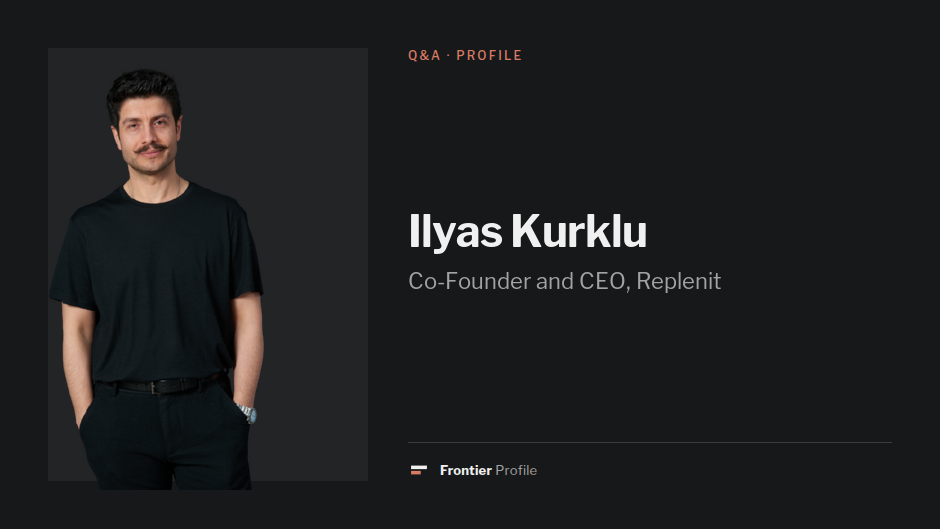
Ilyas Kurklu is Co-Founder and CEO of Replenit, an AI decision engine for retail that turns customer signals into real-time, individualised decisions. Founded in 2025 and headquartered in Warsaw, Replenit works with more than 30 retailers globally - including L'Occitane en Provence, Beko, Whirlpool and The Estée Lauder Companies - and has raised $2.5 million in pre-seed funding led by Movens Capital. Before founding Replenit, Ilyas spent over a decade in international B2B SaaS and martech, working across customer success, enterprise growth and regional operations.
My questions are in bold - over to you Ilyas:
Who are you and what's your background?
I'm Ilyas Kurklu, Co-Founder and CEO of Replenit, an AI decision engine for retail. Before founding Replenit, I spent over a decade in international B2B SaaS and martech, working across customer success, enterprise growth and regional operations.
I previously worked alongside my five co-founders at a global martech unicorn, where we developed deep expertise in AI-powered customer engagement and worked with hundreds of retailers across different markets. That experience gave us a close view of how retail technology had evolved and where the gaps still existed.
What is your job title and what are your general responsibilities?
I'm the Co-Founder and CEO of Replenit. We are six founders who have spent our careers building enterprise martech for global retailers. Over the years, we kept seeing the same problem: retailers were investing in more tools, but the way they worked wasn't really changing.
My role is to define what a new AI-native operating model looks like for retail and turn that vision into products. Our first product is Maestro, an AI CRM Manager that doesn't just assist teams but takes ownership of the work. We see it as the first step towards building an AI workforce for retail.
I'm also closely involved in shaping our research and technology direction, working with AI researchers and academics to ensure what we build has a strong scientific foundation. At the same time, we're building Replenit as an AI-native company, using AI in our own operations so a small team can deliver the output of a much larger one.
Can you give us an overview of your business?
Replenit is an AI decision engine for retail. AI is at the core of the product, sitting between the customer data retailers already have and the systems they use to act on it.
Retailers have CDPs, warehouses, CRM and marketing automation platforms, but the decision of what should actually happen next for each individual customer is still often left to static rules, broad segments and campaign workflows. Replenit fills that gap. It understands customer and product context, decides the appropriate next action and sends that decision to the retailer's existing systems for execution.
We founded Replenit in 2025 and are headquartered in Warsaw. Today, we work with more than 30 retailers globally, including L'Occitane en Provence, Beko, Whirlpool and The Estée Lauder Companies. We have also raised $2.5 million in pre-seed funding led by Movens Capital.
What problem do you solve with AI?
Working with hundreds of retailers across different markets, we kept hearing and seeing the same problem: retailers had become very good at collecting data and very good at execution, but the intelligence in between was still missing.
They've had CDPs, warehouses, CRM platforms and marketing automation systems, yet the decision of what should actually happen next for an individual customer was still largely based on static rules, broad segments, campaign calendars and human judgement.
Even as those platforms add predictive scores, generative AI and send-time optimisation, the AI may optimise something a marketer has already chosen to do. It does not necessarily decide whether anything should happen at all, which lifecycle objective matters most, which product is relevant, why now or towards which commercial outcome.
That's the difference we see between a prediction and a decision. Replenit was built around AI from the outset to make those individual decisions at a scale that rules, segments and human judgement alone cannot. This results in customer experiences that feel genuinely personalised rather than downstream of mass marketing.
What does the AI actually do, and how is it built?
There are four main parts to how Replenit works. Golden Memory builds a living picture of the customer, product and brand rather than looking at each transaction in isolation. With more than 100 industry skills it then helps the system understand things like product substitution, compatibility and when not to recommend something.
Our Theory-of-Mind reasoning adds individual context - what a customer's behaviour suggests they may need and whether this is the right moment to act. Maestro, our AI CRM Manager, uses that context across replenishment, cross-sell, engagement, win-back and churn to decide the next best action for each customer.
For example, it might look at a customer's purchase history, understand their relationship with a product and decide whether the next step should be a replenishment reminder, cross-sell, win-back attempt or simply doing nothing. Each decision becomes a Golden Decision Event that can be passed directly into the retailer's existing systems. Behind this is a swarm architecture, where specialised AI agents work together to reach a decision.
We've built our own models and infrastructure, giving us greater control over how the system reasons and makes decisions.
Who are your target customers, and what's your revenue model?
Our customers are enterprise retailers who have reached a point where their existing tools and ways of working can only take them so far. It's not that they lack talent or data, but driving further growth often means adding more people, campaigns and rules. That's the challenge we're trying to solve.
We work with retailers across beauty, pharmacy, grocery, electronics and fashion, including brands such as L'Occitane en Provence, Beko, Estée Lauder and The Body Shop.
Our business model is also a little different. Rather than simply selling software, we offer Maestro as an AI teammate that works alongside a retailer's existing systems. It operates on a subscription model, much like hiring someone for the team.
The key difference is accountability. We commit to delivering at least a 10x return on investment and our commercial model is tied to the results we achieve.
What's the evidence it works, and what have you learned along the way?
Today, Replenit works with more than 30 retailers globally and we are already seeing clear commercial results. For L'Occitane en Provence, Replenit delivered a 235% increase in post-purchase revenue, while at iBOOD it contributed 6.3% of total revenue.
One of the biggest things we've learned is that retailers don't necessarily have a data problem. They have a data quality problem. There is usually a lot of data, but it can be inconsistent, incomplete or fragmented across different systems. For AI to make good decisions, it needs enough context even when the underlying data isn't perfect.
The other big learning has been around trust. People still need to set the strategy and objectives, while AI handles individual decisions within those boundaries. We then track what happens and feed those outcomes back into future decisions.
How do you handle the data question?
Enterprise retailers are right to ask these questions, and our approach is straightforward: the retailer's data remains theirs. We act as a data processor on their behalf, not as a company looking to build its own data assets from their customers.
The industry has spent a decade telling retailers they need to centralise everything, build a single customer view and complete a large data project before they can act. We found the opposite. Maestro can work with data retailers already have, such as order history and product catalogues, so there's no need to build a new system of record or move large amounts of customer data. We work with pseudonymised customer IDs, while the retailer's own systems handle delivery to the customer.
The data stays in a controlled environment. We run on Google Cloud in the EU, and our AI models are hosted within our own infrastructure rather than sent to third-party AI providers. Customer data doesn't leave that environment.
For regulated sectors such as pharmacy and healthcare, we operate under GDPR data processing agreements, limit the data we use to what's necessary and follow each retailer's security review process. Our infrastructure also undergoes regular independent penetration testing.
If you had a magic wand, what one thing would you change about how AI gets bought and deployed?
I'd change the idea that adopting AI is mainly about adding another tool. A lot of companies are buying AI to make existing tasks faster, when the bigger opportunity is to rethink how the work itself gets done.
I'd like to see companies start by asking where AI can take real ownership and deliver a measurable outcome, rather than where they can simply add an AI feature. That shift would make AI adoption much more meaningful.
What's your message for the large enterprises evaluating AI right now?
Don't evaluate AI only on what it can generate or how much time it can save. Look at whether it can take on meaningful decisions and deliver measurable outcomes.
That also means being clear about what success looks like. Define the business goals and KPIs first, then evaluate whether the AI can work towards them in a way that is transparent and accountable. The technology matters, but so does knowing exactly what you want it to achieve.
Can you list three people you rate from the AI sector that we should be following on LinkedIn, and why?
1. Mati Staniszewski, Co-Founder and CEO, ElevenLabs
Mati has shown what a European AI company can achieve. He co-founded ElevenLabs in 2022 with Piotr Dąbkowski, bringing experience from Palantir and BlackRock. What I respect most is his discipline: research-led, product-obsessed and commercially focused from day one. He's also one of our angel investors and his perspective on building a research-led company has influenced how we approach things at Replenit.
2. Ethan Mollick, Professor, The Wharton School
Ethan is the clearest voice on what AI actually changes in how work gets done. He studies the effects of artificial intelligence on work, entrepreneurship, education and co-directs the Generative AI Labs at Wharton. His work cuts through the hype with evidence, which matters to us because our whole thesis is that AI changes the operating model, not just the tools. He's also a reminder that rigorous research and practical impact belong together.
3. Andrew Ng, Founder, DeepLearning.AI and AI Fund
Andrew saw early that the real shift is from AI that answers to AI that works. He has described seeing a trend where language models would be built into complex, multistep agentic workflows rather than just generating an output and he has argued that most of the value will sit at the application layer. That's very much aligned with what we're building at Replenit: AI that takes ownership of real work within an industry.
What AI tools do you personally use day to day?
The honest answer is that I don't use AI tools. I work with an AI workforce. Most companies still treat AI as software: something you open, prompt and close. We decided early that this was the wrong mental model, for retailers and for ourselves. If we're telling the market that AI should join the team and do the work, we have to run Replenit that way first.
So every function in the company, from sales and product to marketing, research and operations, runs on its own AI workforce. Each one carries more than 20 skills we've designed ourselves, covering how we research a customer, build a proposal, analyse a conversation, report to investors or assess a competitor. Each skill captures how our best people work, so the quality of our best day becomes the standard every day.
We've taken it one step further. Each founder works with an AI counterpart shaped around their own personality, judgment and way of thinking. It knows how I write, how I evaluate a decision and what I would challenge. Six founders operate with the reach of a much larger leadership team, without losing what makes each of us distinct.
We also deliberately don't depend on any single tool. Models and platforms change every few months; what lasts is the knowledge we encode in our skills and the way we work with them. The advantage isn't in the software underneath. It's in what we teach it.
What's the best new AI product or service you've seen recently?
The most interesting AI launch I've seen recently is Jev by TypeSafe AI. While most of the industry is racing to build bigger models that generate more text, TypeSafe went the other way: Jev doesn't write at all. It makes fast, structured decisions that software can act on directly. TypeSafe's CEO, Diogo Almeida, helped create RLHF and ChatGPT at OpenAI before leaving to build a different class of models for AI-powered software rather than agents. To me, that's where real business value sits. Retailers don't need more content; they need better decisions, made faster and at scale. Jev is a sign that the industry is starting to see AI as a decision layer, not just a writing tool.
Finally, let's talk about predictions. What trends do you think are going to define AI over the next year or so?
1.AI will start to look less like software and more like a workforce.
Today, most companies buy AI the way they bought software: seats, features, dashboards. Over the next year, the question will change from "which AI tool should we use?" to "which work should AI own?" Companies will start hiring AI into roles, with responsibilities, goals and performance reviews, not installing it.
2. The operating model is the bottleneck, not the technology. The models are already good enough for most business work. What holds companies back is that their teams, processes and tools were designed for humans doing everything manually. The winners won't be the companies with the best AI, they'll be the ones willing to redesign how they work around it.
3. Skills become the new competitive advantage. Most businesses will have access to similar models. The difference will be what they teach those models about their customers, industry and ways of working. That internal knowledge will become a real asset.
4. Vendors will have to own outcomes. Buyers are increasingly tired of investing in technology that promises results but delivers little beyond dashboards. As AI starts taking on more of the actual work, pricing models will also need to change. I expect more companies to tie their revenue to the outcomes they deliver, with buyers increasingly asking vendors what results they're willing to commit to.
5. Better decisions will matter more than more data. For a decade, companies were told they needed to collect and centralise everything before they could act. AI is breaking that logic. The companies that move fastest will be the ones that act intelligently on the data they already have, rather than waiting for the perfect data project.
Many thanks to Ilyas for taking the time to share his insights with Frontier Profile. You can learn more about Replenit on their website.