Rhys Harris, AI Product Director, Content Guru
Rhys Harris on orchestrating AI models for enterprise CX, sovereign AI deployment, and why consumption-based pricing doesn't work for mission-critical contact centres.
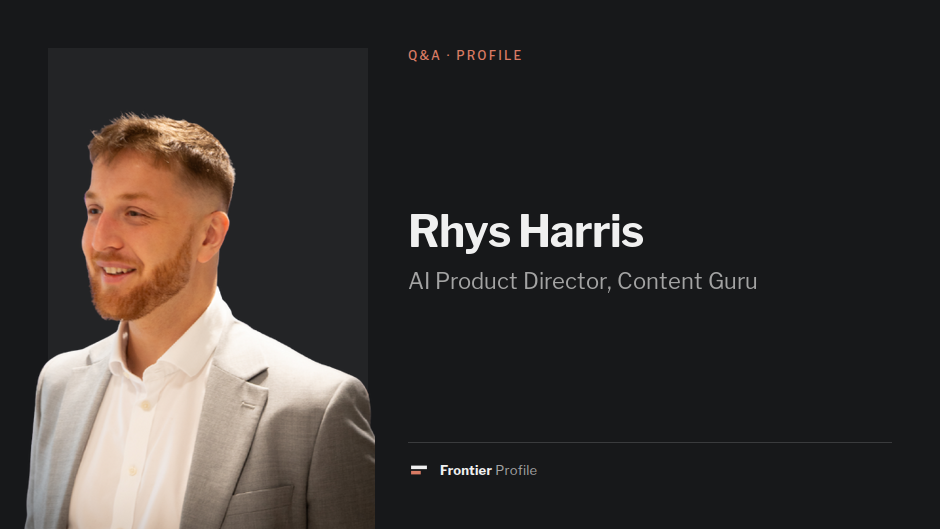
Rhys Harris is AI Product Director at Content Guru, Europe's largest Cloud CX provider, where he leads the brain® AI product portfolio. With a background in physics and six years as Global Head of Service, Rhys now focuses on building scalable agentic AI solutions that deliver measurable ROI for large enterprises and governments across front-office, mid-office and back-office operations.
My questions are in bold - over to you Rhys:
Who are you and what's your background?
I'm Rhys Harris, and I lead the brain® product portfolio at Content Guru. I joined Content Guru in 2016 as a Support Engineer after I graduated with a bachelor's degree in Physics from the University of Bristol. After that, for six years, I was Global Head of Service, responsible for the "run" side of the business and our customer relationships once projects went live.
For my education, I knew I wanted to do something mathematical, and physics blended complex mathematics in a practical problem-solving environment. I also love that physics takes you from the smallest things in the universe to the largest. The logical thinking skills gained from my degree, and my passion for computers and technology started me on my path to AI.
What is your job title and what are your general responsibilities?
I am the AI Product Director at Content Guru, which means I'm responsible for our brain® AI product portfolio, including how AI is implemented through brain®, our AI orchestration layer. My main focus is building scalable solutions that deliver agentic AI capabilities into front-office, mid-office and back-office of organisations to ensure they provide the best CX for their customers.
We call our AI products machine agents, and they have two purposes: they can automate an interaction or workflow end-to-end, as a voicebot or chatbot, so no human needs to be involved, or they can augment a human agent for example through agent assist by understanding the context of an interaction and providing recommendations, compliance guidance or suggesting the next-best action.
Can you give us an overview of your business?
Content Guru has been around since 2005, and our parent company, Redwood Technologies Group, since 1993. We deliver highly scalable, highly resilient, mission-critical customer experience (CX) services on our storm® cloud platform, and our AI offering is held to the same standard. We have more than 20 years' experience delivering cloud services at scale in mission-critical environments.
AI has always been front of mind for us. The brain® trademark we use for our AI portfolio predates my time at the company. Intelligent automation has always been central to delivering high-impact CX, and AI is an evolution of intelligent automation. Our central focus is AI that delivers practical return on investment (ROI) for customers.
We've been working with AI since the 2010s. We have moved from delivering natural language processing (NLP), language detection and machine learning solutions, and we're now into agentic workflow automation and content generation.
What problem do you solve with AI?
Our AI portfolio is driven by customer demand and the need to automate. AI is a tool for solving our customers' problems, such as ensuring their customers can reach organisations easily and get the right information first time.
The big change is what customers can now automate. Traditional natural language processing captured a caller's intent and used it to route them to the most appropriate available human agent. With agentic AI, you can capture very complex intent, connect through standard protocols to systems of knowledge and systems of record (such as a CRM or Customer Data Platform), and complete the whole process end to end, such as logging or updating an insurance claim, or checking the status of a retail delivery. The possibilities are almost limitless, and the way we've designed our products makes them very easy to implement out of the box for customers worldwide, whatever their language or accent.
AI is exceptionally powerful, but it isn't the answer to every automation problem. If I'm discussing a use case with a customer and I don't think AI is the best fit, I'll say so. Sometimes deterministic automation is the better answer. What matters more is that our customers deliver the best experience for their own customers.
What does the AI actually do, and how is it built?
Developing your own foundation model is a highly specialised capability. Much of our value lies in orchestration: choosing and using the right model and managing the customer's context specifically for each customer's use case. We work closely with leading model providers including OpenAI, Google, IBM and many more. We've also integrated with a number of specialist models and fine-tuned open-source models for our sovereign AI offering.
For us, orchestrating multiple AI models is incredibly important. One of our customers operates across several European countries, and often speech-to-text providers perform much better than others in particular European languages. Because we orchestrate, we could use one provider for Romanian and another for Polish, giving the customer the best result across the whole business.
Who are your target customers, and what's your revenue model?
The organisations we work with are running on fixed budgets need predictability, and consumption-based AI pricing doesn't give them that. Token based consumption might as well be called money as each token maps to a cost. In my view, they're an abstraction that makes it harder for customers to work out what they'll spend and how they'll use it.
We designed our portfolio to be as easy to forecast as possible. Our AI products are typically licensed per seat, with a bundled fair-usage allowance which is set for a reasonably productive contact centre or CX organisation, so most customers never need to pay for overage. The same model covers all our machine agents: autonomous voicebots and chatbots, transcription and summarisation, and agent assist.
What's the evidence it works, and what have you learned along the way?
One of the best and worst things about AI is that it isn't deterministic. I can't tell my team to write a test script that says "Do A, then B, and check the result," because the result will be slightly different every time. We ran into this plenty of times early on: we'd build a customer use case, test it many times, and then a slight change in audio quality or accent could change the AI's output significantly. To control that, we built an automated framework that generates test cases, automates our testing, and checks our production services for drift from the set parameters. Our automated testing has removed much of the randomness, and we can deliver much faster with more accurate results.
In terms of successful use cases, we have many customers seeing a return on investment (ROI) from their AI deployments with us. At the DVLA, brain redirects an average of 26,000 customer interactions a month, cutting navigation time in the queue by 50%, reducing Average Handling Time by 2.5 minutes, and lifting First Contact Resolution to 86.6%. At Together, a specialist mortgage lender, AI automatically transcribes and summarises complex assessment calls for underwriters, halving Average Handling Time and improving call quality and workforce efficiency across sales and underwriting teams. AI call-routing and triage for NHS 111 London region handles over 3 million urgent calls a year, stabilised wait times despite a 40% staff vacancy rate, redirected over 90,000 hours of clinical capacity to critical cases, and delivered an ROI of over 150x in its first year.
How do you handle the data question?
We have a mature AI governance framework, and we expect to achieve ISO 42001 certification by the end of this year. Our AI Governance Board approve any AI tool or provider before it's brought into the organisation, which includes a range of contractual checks.
We operate globally, with regional availability zones for our storm® services, and wherever possible our AI partners support the same regional sovereignty requirements. Our first option is our own GPUs, where we can run transcription and language models, in data centres where we know exactly where the servers are. This process gives us a high level of control over model training, data sovereignty, and where data is processed and stored. For customers with the most sensitive requirements, we deploy on our own GPUs on-premises.
As a UK-headquartered company that is still part of the wider European market, we're also very conscious of laws like the US CLOUD Act, which can require US companies to hand over data even when it isn't stored in the US. We maintain a partner network that can support Europe-only sovereignty.
When we do need a frontier model that we can't replicate on our own infrastructure, our data processing agreements with partners, which flow through to our customers, include contractual guarantees that customer data will be processed and stored within the region.
What's new at the company, and what's coming next?
We have an extensive pipeline of new models in the pipeline. On our own roadmap, we're bringing brain® machine agents natively into storm®, with native prompting and agent creation for digital chatbots. We already orchestrate this through our partner network, and we're now building it into the platform itself, on top of our pre-existing voicebot offering.
We've also recently opened a new office and availability zone in Australia, and we see real AI opportunities in the Australian market and across APAC.
On governance, we passed our ISO 42001 Stage 1 audit and are working towards Stage 2, aiming for certification by the end of the year.
If you had a magic wand, what one thing would you change about how AI gets bought and deployed?
In my personal opinion, AI is becoming the battleground of a new Cold War. AI was a central theme of the recent US-China summit in Washington, and arguably a more prominent topic of discussion than trade and the major geopolitical conflicts. I'd want my magic wand to bring more investment for UK and European-native AI companies and model development.
What's your message for the large enterprises evaluating AI right now?
We work with many large enterprises. In our recent brain2050 webinar I looked at adoption statistics and barriers to adoption.
Large enterprises have the most to gain from AI implementations as the scale of the operations means that incremental savings have a much larger effect than they would on a small business. In my experience, they're on the ball, and rightly thorough in how they assess technology, security, data processing, and technical design.
My advice comes down to two things, and they apply to organisations of any size. Firstly, AI is only as good as the context you give it. If your organisational knowledge and systems are in a state where a person can find what they need without a lot of instruction, you're in a good position to adopt AI effectively.
Secondly, don't give in to pressure to adopt AI before you understand your use cases and where you expect a return on investment. If you start a project but don't know, for example, your average cost to serve a contact, you'll never know whether your AI spend has improved efficiency or lowered your costs. Measure your baseline stats, decide how much you want those numbers to change, and agree on those success criteria as part of the implementation.
Can you list three people you rate from the AI sector that we should be following on LinkedIn, and why?
Aishwarya Naresh Reganti, Founder and CEO of LevelUP Labs. Aishwarya shares applied GenAI research summaries and practical guidance for building AI products.
Clem Delangue, CEO of Hugging Face. Clem writes about the open-source AI ecosystem and trends.
Ethan Mollick, Professor and Co-Director of the Generative AI Lab at The Wharton School. Shares evidence on how organisations actually adopt AI and what it does to productivity.
What AI tools do you personally use day to day?
I use AI to help with my documentation and to create videos which help me to visualise ideas in my head with the marketing team, who can turn them into brand-approved material that sits alongside our AI work. Claude is my go-to.
Earlier this year, I attended the NVIDIA GPU Technology Conference GTC, which was a great experience. I didn't have my laptop with me, so I couldn't join the hands-on build workshop, but since then I've been using OpenClaw with various different language models to build my own personal assistant at home.
What's the best new AI product or service you've seen recently?
Apart from the obvious (Claude), very recently I have started using OpenAI's GPT-Live voice model to build personal voice assistants. It's eerily lifelike, to the point where you almost want it to sound more like an AI. The team set me up with a test number for one of our trial voicebots running on the model when it was first released, but when I called and asked for directions, I genuinely thought I'd dialled a wrong number and reached a very helpful person(!)
I'd also highlight the big improvements in Computer-Use AI (CUA) systems, which is how AI models can now take actions directly on your desktop. If it's implemented well and with low latency, it opens up a huge range of possibilities for what AI can do for people day-to-day.
Finally, let's talk predictions. What trends do you think are going to define AI over the next year or so?
In practice, there's still a big gap between organisations that are experimenting with AI or running pilots and those that have gone into production. The main reasons are data sovereignty and security concerns, a lack of clear ROI metrics, and data that isn't good or accessible enough for AI to make informed decisions.
I think that procurement practices will change in line with regulations. Standards like ISO 42001 will become the norm, which will make AI easier to buy. I also expect AI prices to settle at the hardware and model-usage level, even if those savings aren't all passed on to consumers.
If those foundations are right, they'll enable the next wave of AI developments. Very lifelike voice models, which, when combined with low-latency video generation, will enable organisations to generate an AI brand avatar that can interact with customers and answer questions.
Brazilian retailer Magazine Luiza's digital avatar, Lu do Magalu, is already the world's most-followed virtual influencer. Instead of watching a pre-recorded 30-second reel on Instagram, you might be able to go to their website and talk to her directly.
Many thanks to Rhys for taking the time to share his insights with Frontier Profile. You can learn more about Content Guru on their website.