Dipto Chakravarty, Chief Product and Technology Officer, Black Duck
Dipto Chakravarty explains how Black Duck puts agentic AI inside the development loop to secure AI-generated code, and why trust in regulated industries depends on evidence and human accountability.
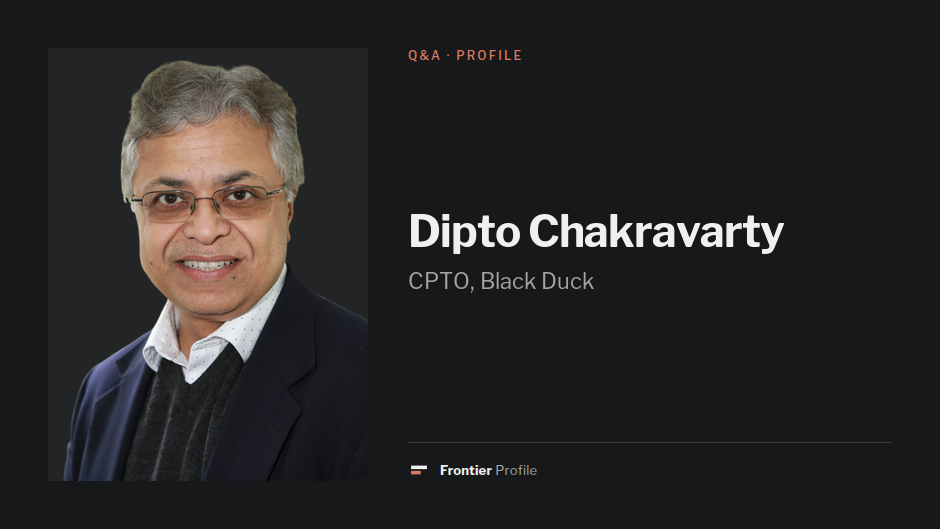
Dipto Chakravarty is Chief Product and Technology Officer at Black Duck, which helps organisations establish trust in the software they build and buy. Before joining Black Duck following its carve-out from Synopsys, he held product and engineering leadership roles at Cloudera, AWS, CA, Novell and IBM, and founded Artesia Technologies through a management buyout. At Black Duck he is responsible for product strategy, development and technology operations, including Black Duck Signal, an agentic AI application security product that scans AI-generated code as it is written.
My questions are in bold - over to you Dipto:
Who are you and what's your background?
I'm Dipto Chakravarty, and I run products and technology at Black Duck. I earned my bachelor's and master's in Computer Science and Electrical Engineering at the University of Maryland and later completed the General Management Program at Harvard Business School.
I started out as a software architect at IBM, then moved to Thomson-Reuters to gain profit & loss experience, where I founded Artesia Technologies through a management buyout. Artesia was later acquired by OpenText.
From there, I held engineering and product leadership roles at CA (now Broadcom), Exostar (sold to Thoma Bravo), Novell, and e-Security (sold to Novell), and led three private-equity-backed businesses through to exits.
Along the way I've had twelve patents issued and have written two best-selling books, published by McGraw-Hill, on computer architecture and operating system internals.
AI came into my work in the form of machine learning in 2013 when I started using random forest, boosting and bagging for combating threat intelligence and advanced persistent threat vectors at ThreatTrack (acquired by Ziff-Davis).
I started using AI/ML at scale at AWS, building data lakes and knowledge graphs, and then was hired to run data engineering in Amazon's Artificial General Intelligence organization at HQ2 in Arlington, VA. My team and I built Amazon’s first LLM and RAG (Retrieval-Augmented Generation) and our learning was priceless.
One of the projects I'm proudest of was helping Alexa book COVID vaccine appointments for millions of people: three teams ingesting and indexing data at scale against a hard deadline. That taught me that AI is only as good as the data quality and guardrails underneath it.
I then joined Cloudera as Chief Product Officer to integrate and cloud-enable complex data platforms from a $5.3B merger of two public companies, before joining Black Duck after its $2.1B carveout from Synopsys.
What is your job title and what are your general responsibilities?
I am a product maker. My formal job title at Black Duck is Chief Product and Technology Officer (CPTO) where I am responsible for all things products, including product strategy, product management, product development, and technology operations.
Day to day, my job is to make Black Duck act as one unified platform. Given that our company is an aggregation of 14+ acquisitions, much of my time goes to setting the product direction, rationalizing the portfolio, working with product and engineering teams on how we build and ship AI responsibly, and spending time with customers, especially in regulated industries, to understand where AI is changing how they build and secure software. Upgrade and speed are easy to add. Trust is the hard part.
Can you give us an overview of your business?
Black Duck helps organizations establish trust in the software they build and buy. We find security vulnerabilities in proprietary code, open-source code and license risk across the software supply chain and give regulated enterprises the evidence they need to prove their software is secure and compliant.
Our portfolio covers static analysis (Coverity), software composition analysis (Black Duck SCA), dynamic and interactive testing, protocol fuzzing, application security posture management, and audit services, all available on-prem or in the cloud as a SaaS service.
AI is both a product and a capability. Our Black Duck Signal solution was announced in December 2025, several months before Anthropic announced their Claude Security offering. Since then, we have also released a set of AI-native agentic workflows built for agentic development: a coordinated team of specialized security agents that analyze code, validate findings, triage incident response, and guide remediation in real time. At the same time, we're building AI into our established products. Coverity now offers AI-assisted triage, AI-powered vulnerability detection, and an MCP server for AI coding agents.
On scale and backing: Black Duck's heritage goes back more than two decades as a trusted software security brand. In October 2024, we became an independent company when Clearlake Capital and Francisco Partners acquired the former Synopsys Software Integrity Group. Fast-forward to 2026 (two birthdays later), Gartner has named us a Leader in its inaugural Magic Quadrant for Software Supply Chain Security. Plus, Gartner continues to see us a Leader in application security testing for nine consecutive years.
What problem do you solve with AI?
The problem is trust in software, and AI has made it bigger.
AI coding assistants, IDEs, and agents now generate a large share of code at machine speed. Security built for human-paced pull requests (PRs) either becomes the bottleneck or gets bypassed. AI-generated code (or vibe code) also brings in open-source components and snippets in which a human didn’t consciously choose. Every organization that ships software has this problem, and it's most acute for automakers, aerospace, banks, healthcare, medical-device makers, and the public sector, where a vulnerability is a regulatory event as well as a security one.
I like to say AI coding assistants are the most productive junior developers we've ever hired. They never sleep, and now and then, they import a library last maintained in 2014, with both confidence and ignorance. Enthusiasm is not the same as judgement.
AI came to Black Duck as an established business. We've spent more than 20 years building deterministic analysis that produces precise, explainable findings, and a system of record, and that remains our foundation. What has changed is the speed and volume of AI-native development. Security now must sit inside the agentic development loop, not at the end of it. That led us to build Signal and to bring AI into Coverity, SCA and the rest of our solution portfolio.
What customers can do now that they couldn't before: get validated, prioritized findings and trusted fixes at the moment code is generated, inside the AI tools developers already use. Security teams spend far less time on false positives and manual triage, and can produce continuous evidence for compliance instead of point-in-time reports.
Wearing my CTO hat, I see this as an accountability problem as much as a technical one. Wearing my CPO hat, I see it as a trust problem as much as a feature problem. And guess what, in regulated industries, they're the same problem!
Consider an automobile, bank, or a hospital, "the AI wrote it" is not an acceptable root cause in an incident report. Regulators hold people and institutions accountable, not models. So, our job is to let AI do the heavy lifting while a named human stays accountable for what ships, and to give that human the context to make a confident call in seconds rather than hours.
What does the AI actually do, and how is it built?
AI is pervasive at Black Duck; it persists in every layer of the tech stack. The foundation is deterministic analysis: static analysis, software composition analysis, and dynamic testing. Generative AI sits on top, explaining a vulnerability in plain language, suggesting a fix, or summarizing risk for an executive or a high-level analyst. Agentic AI is the next layer: systems that triage, validate, prioritize, and remediate across a workflow as an ensemble without a human in every step.
Put simply, the deterministic engines are the strict auditor and the language models are the gifted storyteller. We let the storyteller explain, but the auditor signs off. Nobody wants a vulnerability report that begins "Once upon a time..."
Here's a real example. A developer is working in Claude Desktop, or Cursor, and asks the assistant to build a new feature. Through our Model Context Protocol (MCP) integration, Black Duck Signal scans the git changes, a file, or the whole project as the code is written. Agents analyze the code, check whether a finding is exploitable, assess its impact, and propose a fix. The results come back as structured “context” the assistant can reason over, so the developer can ask "why is this risky?" or "fix it" in plain language, without leaving their workflow.
Under the hood, Signal uses specialized agents grounded in ContextAI, our specialized AppSec model built on more than 20 years of security, ground truth from millions of real-world proprietary and open-source codebases. For the language models, we deliberately chose not to lock customers into one provider. Customers can use Black Duck-managed LLM endpoints or bring their own, and each agent can be pointed at a different provider, model, and endpoint.
In August 2026, we also joined Anthropic's Project Glasswing, applying the Mythos model across our portfolio alongside our deterministic engines. Our approach is to build what makes us unique, which is the security intelligence, ground truth and workflows, and to partner with frontier models.
From my vantage point, the design rule for regulated environments is that AI proposes and humans dispose of anything consequential. Agents can triage, validate, and draft fixes on their own, because that work is reversible and low-risk. Changes that reach production go through the customer's existing controls: code review, change management, and segregation of duties. Our goal is that every agent action carries the evidence behind it, so an auditor six months later can reconstruct what happened and understand why. Autonomy is something an agent earns with evidence, not something it's granted on day one.
Who are your target customers, and what's your revenue model?
Black Duck serves organizations ranging from high-growth software companies to Fortune 100 enterprises, with particular strength in regulated and safety-critical industries including automotive, aerospace, healthcare, financial services, defense, the public sector, and embedded systems.
Our solutions are designed for organizations building software at scale, often across complex, multi-language environments with extensive open source adoption and growing use of AI-assisted development. These organizations frequently operate under stringent security, compliance, and governance requirements, including regulations such as the EU Cyber Resilience Act (CRA) and FDA software guidance, and must provide auditable evidence to regulators, customers, and stakeholders.
Most AI capabilities are included as part of Black Duck's core product offerings, including Polaris, Coverity, and Black Duck SCA, reflecting the reality that AI-enhanced functionality is quickly becoming a standard expectation in modern application security programs.
Black Duck’s Signal Code Analysis is different. As an AI-powered code analysis solution that uses LLM reasoning to identify security defects often missed by traditional SAST and SCA tools, it is offered as a separate product. Advanced AI capabilities such as Signal deliver value beyond conventional application security testing by increasing developer productivity and helping organizations scale security efforts without adding headcount. Because these capabilities require significant AI compute resources and token consumption, Signal follows a consumption-based pricing model, similar to other specialized AI services.
What's the evidence it works, and what have you learned along the way?
Last year, with insights and data provided by over 100 Black Duck customers across several industries, our customer value study demonstrates the transformative impact Black Duck solutions have on the world of software development. The study shows customer improvements across productivity, risk mitigation, and cost.
Namely, the study found a 66% reduction in average remediation time, a 42% reduction in time spent on manual code quality and security reviews, a 75% reduction in time spent preparing risk reports and audits, a 55% drop in releases delayed by security issues, and more than 4 hours per week for developers to write new code.
Lesson 1: Early AI triage worked well in testing but needed grounding in deterministic results to earn developer trust. Explainability beat raw accuracy from what I see as a practitioner and a builder.
Lesson 2: Pilots stall when they're built to prove the model rather than fit existing toolchains. Integrating where developers already work (IDE and CI) drove adoption. Lesson 3: Regulated customers wouldn't send code to a single 3rd party model, which led directly to bring-your-own-LLM. Model choice turned out to be a governance feature.
Lesson 4: "It works on my laptop" now has a cousin: "it works on the benchmark". Real codebases are messier than test repos, so we measure in production, on customer code, with humans reviewing the edge cases.
Lesson 5: Leaders must practice one-way vs. two-way door decisions; and leaders must keep a human-in-the-loop (HITL) for consequence and/or actions.
How do you handle the data question?
This is the first question every customer asks us, and rightly so. Our principle is to give customers sovereignty over the model, not just the data. With Signal's bring-your-own-LLM configuration, source code and analysis prompts stay inside the customer's own cloud tenancy or on-prem network. Each agent can be pointed at a model provider and endpoint the customer has already approved under its existing enterprise agreements. Coverity's new AI capabilities likewise run on the customer's LLM of choice, so the customer controls where code and scan data are processed.
Put another way: your code is yours. We would never send it to an AI model you haven't explicitly approved, just as we wouldn't email it to a stranger for a "quick review." It's an important distinction, and one worth considering.
Automakers, banks, healthcare providers, and government agencies have spent years building model risk management and third-party risk management processes. Black Duck integrates into those existing processes rather than forcing new ones. And for customers with strict data residency, security, or compliance requirements, our core analysis engines have long been available for fully on-premises deployment.
Having run large organizations, I believe trust in regulated industries rests on three elements. The first is transparency: which model, where it runs, and what it saw. The second is control: customers can switch AI off, swap the model, or require human approval at any step. The third is evidence: a complete audit trail. Human judgement remains the final control. DORA's operational resilience requirements, FDA cybersecurity expectations, and the EU AI Act’s provisions for human oversight all reinforce the same principal: AI should help experts work faster and make better-informed decisions, not replace human review and approval.
What's new at the company, and what's coming next?
It has been an exceptionally active year for Black Duck.
In March, we reached general availability for Black Duck Signal, bringing agentic AI-powered application security to AI-generated code.
In July, we expanded Coverity with AI-assisted triage, AI-powered IDOR detection, an MCP server for AI coding agents, and capabilities designed to support EU CRA compliance.
In August, Signal was added to the Claude Directory, enabling real-time vulnerability scanning within Claude Desktop.
More recently, Black Duck joined Anthropic's Project Glasswing to help secure critical software systems in the AI era and became a participant in Chainguard’s Project Athena to provide customers with earlier visibility into emerging vulnerabilities.
If you had a magic wand, what one thing would you change about how AI gets bought and deployed?
AI is cloud all over again from 20 years ago, from the shadow pilots to the regulators' data questions, except that cloud moved our servers and AI moves our decisions, at 5X the speed.
If I could change one thing, it would be to make choice, transparency, and evidence the default requirements for AI adoption. The most successful AI deployments should allow customers to bring the model they've already approved, retain their data sovereignty, and prove what the AI did and why with a clear audit trail and context. This approach reduces model-risk concerns, shortens compliance reviews, and helps us move from pilot to production with significantly less risk.
Too often, enterprises are asked to accept a single vendor's model, send their most sensitive data to someone else's infrastructure, and trust a demo instead of evidence. That may accelerate a pilot, but it often creates longer-term challenges around governance, compliance, and trust. In many cases, this hidden complexity becomes an "AI tax" that slows deployment far more than the technology itself.
I'd also make human oversight a first-class design principle rather than an afterthought. The most effective AI systems clearly distinguish between what the AI can automate, what it can recommend, and what remains a human decision. That boundary should be transparent, auditable, and easy to adjust as confidence and operational maturity grow.
Ultimately, the future of enterprise AI should not be about asking organizations to trust more. It should be about giving them the visibility, control, and evidence they need to trust with confidence.
What's your message for the large enterprises evaluating AI right now?
My motto: keeping it simple is hard, and making it hard is simple. It's easy to add another AI layer and call it innovation. The AI worth buying absorbs complexity so people don't have to.
Build to the strictest standard you already know. Assume it will apply to AI too. In software, that means the EU CRA, DORA, FDA premarket cybersecurity expectations, ISO/SAE 21434 in automotive, and secure-development attestation in government. Keep a record of what the AI did and why. Make sure a human is always able to override it. Test constantly against ground truth, and show your work to regulators early. Evidence beats assurances.
Speaking as one CPO to another: decide where autonomy belongs before you deploy. Sort decisions into three groups: those AI can make on its own, those it can only recommend, and those that stay with humans. Rank them by reversibility and impact. A suggested code fix that a developer can reject is a two-way door. An agent approving a credit decision or merging into a release branch is a one-way door. Give AI more autonomy only as the evidence supports it, and keep accountable humans firmly in the loop where the stakes are highest. Hallucinations are charming in a poem. They’re much less charming in a payments system.
Remember that AI is now writing our software. The attack surface is growing at machine speed, so security has to run inside the development loop, not sit at the end as a final gate. Don't let pilots die in the lab. Most stall because they're built to prove a model works, not to fit real toolchains and approval workflows. Start from the end state. Measure outcomes such as mean time to remediate (MMTR), not just model accuracy alone. And bring security, risk, and compliance in from day one.
Everyone wants an “AI kill switch”, including pundits, senators, and congressmen to ban or deter artificial superintelligence (ASI) from causing human extinction or an Armageddon. I went looking for a kill switch, given my past tenure working with the NatSec intelligence agencies. There isn’t one. A frontier model isn’t one you can unplug. Rather, it’s a “system of systems.” Myriad suggestions made by experts already has a name; it is called a backdoor. What can stop rogue AI in production is not a switch; it is a revoked API key, a throttle, a government regulation, or relying on Tom Cruise to pull the RAM card out by hand.
Can you list three people you rate from the AI sector that we should be following on LinkedIn, and why?
Andrew Ng, founder of DeepLearning.AI and AI Fund: Andrew has done more than anyone to make AI education accessible and practical at scale. He consistently bridges the gap between cutting-edge AI research and real-world business applications, helping leaders understand not just what's possible with AI, but how to adopt it responsibly and effectively.
Lenny Rachitsky, author of Lenny's Newsletter: Lenny offers some of the most insightful thinking on product leadership and organizational change. His work is particularly valuable for understanding how AI is transforming product development, decision-making, team structures, and the skills leaders will need in an AI-enabled future.
Swami Sivasubramanian, AWS: My former colleague, Swami has been at the forefront of helping enterprises adopt generative and agentic AI at global scale. His perspective is especially valuable because it combines deep technical expertise with practical guidance on how organizations can operationalize AI securely, responsibly, and effectively.
Dom Glavach, Black Duck’s CISO: My colleague, Dom is a hands-on security practitioner who is navigating the realities of AI adoption inside large organizations. His commentary is grounded in real-world risk management, software security, and governance, making him a trusted voice on how enterprises can innovate with AI while maintaining security and resilience.
What AI tools do you personally use day to day?
I make a point of staying hands-on with AI, both professionally and personally. In fact, I'm currently in the top 10% of the "Are You in the Weights?" leaderboard, which keeps me motivated to continuously experiment with new tools and workflows.
My daily AI stack includes:
- Claude Desktop with the Black Duck Signal MCP for integrating AI-assisted development with security and governance directly in the workflow.
- Black Duck Signal to dogfood our own agentic AppSec capabilities and better understand how customers secure AI-generated code.
- Cursor, Kiro, Gemini, Kimi, and other coding assistants to stay close to how modern developers are building software today.
- Mistral and Qwen to evaluate the evolving landscape of private, on-premises, and sovereign AI models.
- Perplexity for research, rapid synthesis, and tracking emerging AI tools and trends.
This mix helps me stay current on both the developer experience and the security, governance, and deployment considerations organizations face as AI adoption accelerates.
What's the best new AI product or service you've seen recently?
ChatGPT Astra has caught my attention for how quickly it is evolving toward a more autonomous system with its background execution and OS-level control, which is exciting to see as a product builder. It is an indicator of the future pace of innovation acceleration, and time compression of each innovation before it commoditizes into mainstream toolchain.
Finally, let's talk predictions. What trends do you think are going to define AI over the next year or so?
First, the novelty phase of AI is over. Organizations are moving beyond experimentation and deploying AI in production at scale. As a result, the gap between companies that are successfully operationalizing AI and those that are merely talking about it will become increasingly apparent.
Second, AI is evolving from assistants that respond to agents that act. We're moving toward systems that can triage, validate, prioritize, and fix issues across entire workflows, while humans focus on oversight and judgment. In software security, I expect much of the routine work, including triage, conflation, validation, and first-pass remediation to be handled by agents within the next two years.
My highest-confidence prediction? Boards will start asking, "Are we agentic yet?" long before anyone agrees on what an "agent" actually is.
Third, model sovereignty will become a key buying criterion. Customers will increasingly demand the ability to bring their own models and keep sensitive data inside their own environments. Vendors that force customers into a single-model ecosystems will lose business.
Fourth, compliance will shift from point-in-time attestations to continuous, automatically generated evidence produced as software is built. Regulations such as the EU Cyber Resilience Act will accelerate this transition and make continuous compliance the expected standard.
And finally, open protocols such as MCP will make agents increasingly interoperable. That interoperability will unlock new capabilities but will also raise the stakes for securing agent-to-agent interactions and validating the code those agents generate.
Underlying all of these trends is a single theme: trust. As AI agents gain greater autonomy, organizations, particularly those in regulated industries, will adopt models of graduated autonomy. Agents will be allowed to act independently on low-risk, reversible tasks, while escalating consequential decisions to humans, with every action recorded and auditable.
The organizations that succeed won't treat human oversight as a safeguard added after the first incident. They'll build it into their systems from the start. In regulated industries, trust is ultimately the product. AI simply helps deliver it faster.
Many thanks to Dipto for taking the time to share his insights with Frontier Profile. You can learn more about Black Duck on their website.