Wolter Smit, CEO and Co-Founder, TOPdesk
Wolter Smit on building AI into TOPdesk's service management software, why organisational knowledge comes first, and why autonomy has to be earned gradually.
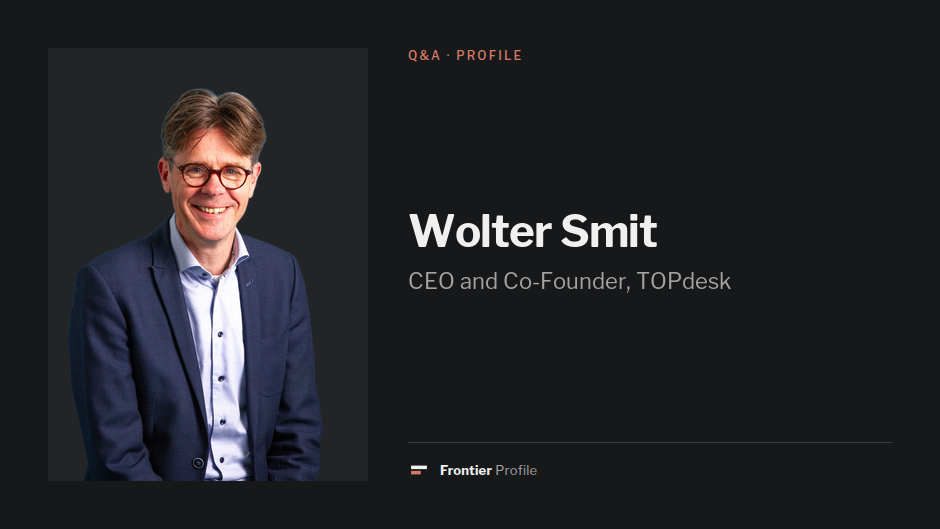
Wolter Smit is CEO and co-founder of TOPdesk, an international service management software company. He started the business in the 1990s, in the days of DOS, to help organisations bring order to IT support, and he still enjoys programming in his spare time. TOPdesk is now building AI into its established software, including TOPdesk Robin, an AI teammate that helps service professionals and employees find answers and resolve requests while keeping people in control.
My questions are in bold - over to you Wolter:
Who are you and what's your background?
I'm Wolter Smit, CEO and co-founder of TOPdesk. My background is in technology and software development. I’ll confess to being a bit of a software nerd. I've always been fascinated by how technology can solve everyday problems. That was why I started the company in the 1990s, back in the days of DOS.
Our original ambition was quite straightforward. It was to help organisations keep track of their work and bring some order to the chaos of IT support. That practical approach has stayed with me throughout my career. I still enjoy programming in my spare time, which has given me a first-hand appreciation of just how significantly AI is changing software development.
What is your job title and what are your general responsibilities?
As CEO and co-founder of TOPdesk, my responsibility is to make sure we're building a business that delivers genuine value for our customers while remaining a place where people enjoy working.
One of the biggest lessons I've learned is that engaged employees and satisfied customers go hand-in-hand. If people enjoy their work, that comes through in the service they provide. I'm also particularly interested in how we respond to technological change, including AI, while preserving the human qualities that have helped TOPdesk grow into an international business.
Can you give us an overview of your business?
TOPdesk develops service management software that helps organisations manage and improve the services they provide to employees and customers. What began as a solution for IT help desks in the 1990s has grown into an international business supporting service delivery across organisations.
AI is now being integrated into our established software to make everyday service management more efficient. We're focusing on practical capabilities such as incident categorisation, ticket summarisation and knowledge management, while keeping customers in control of how they adopt the technology. Our philosophy has always been to make complex work simpler for the people doing it.
What problem do you solve with AI?
Service desks deal with enormous amounts of repetitive work, from categorising requests to answering questions that have come up many times before. This leaves less time for complex problems where human expertise really matters.
AI reduces that administrative burden, which is a major gain for any organisation. But there's another challenge that I think is just as important. Much of an organisation's knowledge is inside people's heads rather than in accessible systems. We're using AI to help teams capture, organise and reuse that knowledge more effectively. Our recently introduced AI teammate, TOPdesk Robin, builds on this approach by helping service teams and employees find the information they need and resolve requests more efficiently, without removing human oversight.
What does the AI actually do, and how is it built?
We've focused on integrating AI into everyday service management workflows. For example, when a service desk receives a ticket, AI can categorise it and summarise the information, helping an agent understand the issue more quickly. TOPdesk Robin helps employees find answers through the self-service portal, drawing on existing organisational knowledge, while supporting service professionals by summarising requests, suggesting next steps and drafting responses. Importantly, the employee remains responsible for reviewing those suggestions and deciding what action to take.
Alongside this, our AI writing assistant and translation capabilities help teams communicate more clearly, while AI-powered search makes information easier to find.
These capabilities are built into TOPdesk, with human verification and controls over AI-generated outputs. We want customers to benefit from AI without introducing unnecessary complexity.
Who are your target customers, and what's your revenue model?
We work with organisations that need to manage service requests efficiently, particularly those handling significant volumes of IT support and internal service delivery. The greatest benefits tend to come when teams have repetitive processes but face growing demands on their time and have valuable organisational knowledge they are unable to use effectively.
TOPdesk provides service management software through a subscription model, with our current built-in AI capabilities included as part of that offering. We want organisations to adopt features that genuinely suit their needs, with predictable costs and support to help them get started, rather than requiring a substantial new technology project.
What's the evidence it works, and what have you learned along the way?
One of the clearest lessons we've learned is that AI depends heavily on the quality of the information available to it. We regularly see organisations struggle to maintain comprehensive, up-to-date knowledge bases, even though those resources become more valuable as AI adoption increases.
Our wider research among UK IT decision-makers also shows where automation is gaining traction, including access requests and service desk ticket categorisation.
The lesson is that organisations shouldn't expect AI to solve problems simply by switching it on. They need to invest in their data, knowledge and processes, and build confidence through practical use cases.
How do you handle the data question?
Data protection and trust are essential, particularly when AI is handling information that may be sensitive or specific to an organisation.
Our approach is to give customers clarity and control over how their information is processed. Customer data remains in its region by default, and we don't use it to train external AI models. We also make AI-generated outputs transparent and provide controls that allow users to review suggestions before they act on them.
For me, responsible AI adoption means organisations should understand what the technology is doing, where their data goes and when human oversight is needed.
What's new at the company, and what's coming next?
We recently introduced TOPdesk Robin, an AI teammate designed to support both service professionals and end users. It builds on our existing AI capabilities by helping employees access organisational knowledge, respond to requests and manage everyday service processes, while keeping people involved in decision-making. Alongside Robin, we're introducing tools to help organisations prepare for AI adoption, including an AI Readiness Dashboard that assesses how well their knowledge bases are equipped to support AI. I think this preparation is just as important as the technology itself.
Looking ahead, I think we'll see growing opportunities for more autonomous, agent-based AI. But organisations need to build trust in those systems gradually. That means starting with straightforward tasks, checking the results and increasing autonomy only when there's evidence that the technology works reliably. Our focus is on helping customers make that transition at a pace that works for them.
If you had a magic wand, what one thing would you change about how AI gets bought and deployed?
I'd change the expectation that AI can simply be added to an organisation and immediately solve its problems. I've encountered the idea that it's a kind of magic wand, but the reality is much more complicated.
AI needs good information, appropriate processes and people who understand where it can add value. I'd like organisations to spend more time identifying the problems they're trying to solve before choosing the technology. Start with something manageable, establish whether it works and build from there. That approach may seem less exciting, but I think it will deliver much more lasting value.
What's your message for the large enterprises evaluating AI right now?
Start with your organisational knowledge. General-purpose AI models are incredibly capable, but they don't automatically understand how your business operates, where information is stored or why a particular decision was made.
That knowledge often sits with employees and needs to be captured before AI can make effective use of it. I'd also encourage business leaders to approach autonomy gradually. They should start with tasks where people can easily verify the results – that builds confidence. Then consider where greater independence makes sense. Human judgement remains essential, particularly when decisions involve risk, competing priorities or empathy.
What AI tools do you personally use day to day?
I still enjoy programming in my spare time, so I've been experimenting with AI-powered software development tools. It's one of the areas where I've seen the most dramatic improvements in what the technology can achieve.
I also see real value in relatively straightforward applications, such as summarising conversations, preparing meeting notes and helping structure written material. What matters to me is understanding the output rather than simply accepting it. AI can be a very effective assistant, but you should still be able to explain and stand behind the work it produces. In written content, human insight and context are still necessary for it to be truly engaging.
What's the best new AI product or service you've seen recently?
The development of AI-powered coding tools has particularly impressed me. I've been writing software for many years, and the progress in this area is remarkable. Tasks that once required considerable manual effort can increasingly be completed with AI assistance.
What's interesting is how this changes the role of the developer. Rather than spending so much time on repetitive technical work, people can focus more on defining the problem, assessing the solution and applying their own expertise. That's a useful example of how I believe AI can improve work more broadly.
Finally, let's talk predictions. What trends do you think are going to define AI over the next year or so?
I expect we'll see continued movement towards agentic AI, with systems taking on more responsibility for completing tasks rather than simply generating answers. But I don't think autonomy will happen overnight. Scaling AI across a business beyond email summaries and similar personal use cases is not easy. We see many AI implementations hit the rocks because they were set up for use cases requiring deterministic behaviour. Others fail because the quality of answers is too low or quite simply, people cannot get used to it.
Organisations will first need to learn where these systems can be trusted. The technology is advancing remarkably quickly, but its value in everyday business operations will increasingly depend on the quality of the context and information it can draw upon.
Many thanks to Wolter for taking the time to share his insights with Frontier Profile. You can learn more about TOPdesk on their website.