Emilis Strimaitis, Head of Product Innovation, Hostinger
Emilis Strimaitis discusses how Hostinger Agent unifies AI-powered website building, hosting, and business growth tools for small businesses worldwide.
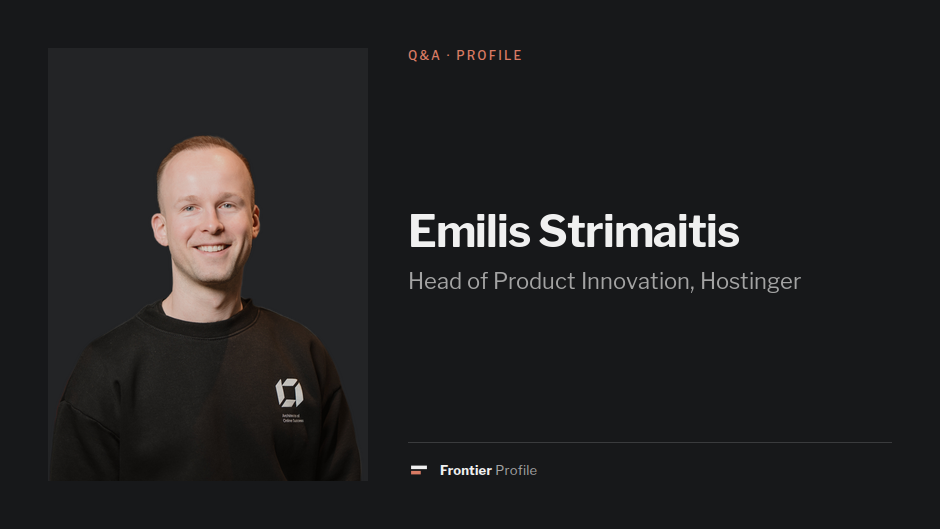
Emilis Strimaitis is Head of Product Innovation at Hostinger, an agentic platform serving 5.7 million active clients across more than 150 countries. Since 2008, he has built online businesses spanning affiliate marketing, digital products and WordPress plugins. At Hostinger, his team develops AI-powered solutions that help small business owners build, run and grow their online presence without juggling disconnected tools. His main focus has been Hostinger Agent, which evolved from a customer-support chatbot into a unified AI assistant handling over 500 technical and administrative tasks.
My questions are in bold - over to you Emilis:
Who are you and what's your background?
I've been building online businesses since 2008. I started in affiliate marketing, moved into digital products and email marketing, and eventually found my way into software, building and launching WordPress plugins. I'm no engineer, but I know my way around code and I know how to talk to freelance developers so ideas turn into products. I've built some companies, scaled a few, and ran one or two into the ground by making stupid mistakes.
Throughout my career, I've tried to hone in on building useful digital products and bringing them to market in new ways. AI has become a natural extension of that work. It's opened up a lot of new possibilities for developing software and solving business challenges. I always worried my being a jack-of-all-trades was a weakness, but it's been instrumental to my work at Hostinger. Turns out my entrepreneurial mindset and product-building experience is ideal for developing AI-powered solutions for small businesses.
What is your job title and what are your general responsibilities?
I'm Head of Product Innovation at Hostinger. My team takes on things that are innovative but don't fit anywhere else, often several at once. Innovation can mean a whole new product, or it can be a button in the right place that adds a few percent to yearly revenue. It helps if you think a bit like a gambler. You make eight bets. Six fail, one is mediocre, but one wins and that's a genuinely good result. Since joining, my main focus has been Hostinger Agent.
Can you give us an overview of your business?
Hostinger is an agentic platform that helps anyone build, run and grow a business online. It brings website and app creation, hosting, ecommerce, email and marketing tools together in one place, reducing technical complexity for customers.
AI runs across the entire platform, most visible to our customers as Hostinger Agent. Hostinger Agent began in 2023 as Kodee, a customer-support chatbot. Now it carries out more than 500 technical and administrative tasks, which is a boring way to say just about everything from domain managing to content writing to privacy policy managing to color-scheme-adjusting. You name it, Hostinger Agent does it. We've even given it specialist capabilities in marketing, SEO, content and business growth. Our AI Builder, which replaced Website Builder and Horizons in August 2026, is where customers create websites, stores and apps, and Reach brings AI to email marketing.
We were founded in 2004 initially focused on hosting, but have now transitioned into a much more complete agentic platform. We serve 5.7 million active clients in more than 150 countries and have nearly 1,000 employees across 54 countries. We're growing 50% year over year, so we've jumped from 50 million to 75 million to 120 million to 180 million to 270 million in what feels like record time.
What problem do you solve with AI?
Small businesses typically rely on multiple disconnected tools to run and grow their online presence, from website creation and customer support to content and SEO. This can make managing a business way more complicated than it needs to be. Hostinger Agent brings these capabilities together in a unified AI experience, meaning customers no longer have to switch between tools in order to build their websites, manage their online presence and grow their businesses. All that happens directly on our platform.
Hostinger didn't start as an AI-native business, but helping customers grow beyond web hosting made AI an obvious strategic priority for us. Today, we integrate AI into our products while also equipping our team with the skills to make the most of it.
What does the AI actually do, and how is it built?
The customer's website or store, domain, business email, marketing and past conversations already live within Hostinger, so the AI can act on them without any setup. There's one chat window and one memory. The customer explains their business once, and each conversation makes the next one more useful.
Behind that one assistant, specialised agents cover marketing, SEO, content and visuals, analysis, and recurring tasks such as scheduled reports. It can also use Hostinger's built-in AI tools mid-conversation to create images and logos. Hostinger Agent is also available inside AI Builder, so customers can build and get help in the same place.
Chat is great, but we didn't put everything into chat. In AI Builder, customers can build by talking to it or by drag-and-drop. Dealer's choice.
Who are your target customers, and what's your revenue model?
Hostinger is for anyone building a business online. Our largest markets are India, Brazil, Indonesia, the US and France, and about 65% of customers are in emerging markets.
The people who get the most out of our platform are small business owners and solo founders who would otherwise be stitching together a website builder, an email tool, an SEO tool and a support desk themselves. More and more, it's also individuals building personal projects that aren't businesses yet. If you want to build it, we want to help.
What's the evidence it works, and what have you learned along the way?
Kodee handled about 1.45 million customer conversations a month before we even merged it into Hostinger Agent. Towards the end of June, we changed how the hardest support cases—one out of every ten, give or take—are handled. A Hostinger specialist now advises the AI behind the scenes instead of taking over, and customers can still ask for a person at any time.
The biggest lesson came from our first agent product, which had seven agents with seven different personalities. Hundreds of thousands of people tried it, and it was clear they didn't want that. Everybody wants to talk to one bot. The second lesson is about people. Bringing our specialists into the loop, rather than handing cases over to them, showed us that AI and humans working together outperform either on their own.
How do you handle the data question?
We follow strict data usage and management policies, and are not training or fine-tuning any AI on customer conversations with our Hostinger Agent. Our users' privacy is paramount, and so we don't share data with third parties for advertising, nor use it to build marketing profiles. Basically, the content of our customers' conversations is stored securely and tied to their Hostinger account.
What's new at the company, and what's coming next?
It's been a busy year. In July we launched Hostinger Ecommerce, which lets customers sell through their website, social channels and shareable links. In August, Website Builder and Horizons became AI Builder, a single tool for creating websites, stores and apps. In September we launched Hostinger Agent, bringing Kodee and our growth agents together into one assistant. Hostinger was also ranked second in the Financial Times and Statista Long-Term Growth Champions: Europe 2026 list and won a Gold Stevie Award this year. Safe to say that no one is sitting around the office twiddling their thumbs.
If you had a magic wand, what one thing would you change about how AI gets bought and deployed?
The AI industry has spent the past two years burying people in an avalanche of assistants, copilots and agents, then making them build a roster. You get a situation where people see this and think they want lots of agents, but they actually don't. Why would a small business owner who doesn't want to manage ten employees suddenly want three separate AIs to play CFO, CMO and CTO? That makes no sense. People like this want one AI, and we aim to give them that.
What's your message for the large enterprises evaluating AI right now?
Give people one assistant, not a team of bots. Our own users told us quite clearly that they were totally uninterested in choosing between this agent and that one. It goes without saying, but let's say it anyway: Keep humans in the loop. Our specialists now advise the AI on the hardest cases instead of taking over, and AI and people working together beats either one working solo. Don't force everything into chat, because people still want visual interfaces and should be able to choose how they work. And don't wait for perfect. Ship, learn from how people actually use it, and keep improving.
Can you list three people you rate from the AI sector that we should be following on LinkedIn, and why?
I actually don't follow that many people on LinkedIn. I'd just recommend using X heavily. The more you use it, the better results you will get, and the For You feed becomes really good. That way I am not following one specific person, but instead I am following the world and the trends in general.
What AI tools do you personally use day to day?
I use Whisperflow daily. It transcribes my meetings, which is great, because there is so much information on the meetings that would get lost if I was just scribbling down notes. I also use it for dictation all the time. I can dictate long prompts for my agents, which lets me achieve actual results faster.
What's the best new AI product or service you've seen recently?
Do I sound like a broken record if I say Whisperflow? I'd be lost without it.
Finally, let's talk predictions. What trends do you think are going to define AI over the next year or so?
To be fair, my guess is as good as anyone's. Who would say, five or six years ago in full pandemic mode, that we'd be discussing RAM usage for AI and propelling cars? Everything is moving so fast, I'm just trying to keep up with the world's pace. Predicting anything seriously is a fool's errand in my opinion.
Many thanks to Emilis for taking the time to share his insights with Frontier Profile. You can learn more about Hostinger on their website.