Glen Williams, Chief Executive Officer, Cyberfort
Glen Williams, CEO of Cyberfort, discusses embedding AI into cybersecurity operations whilst balancing productivity gains against data protection and commercial risks.
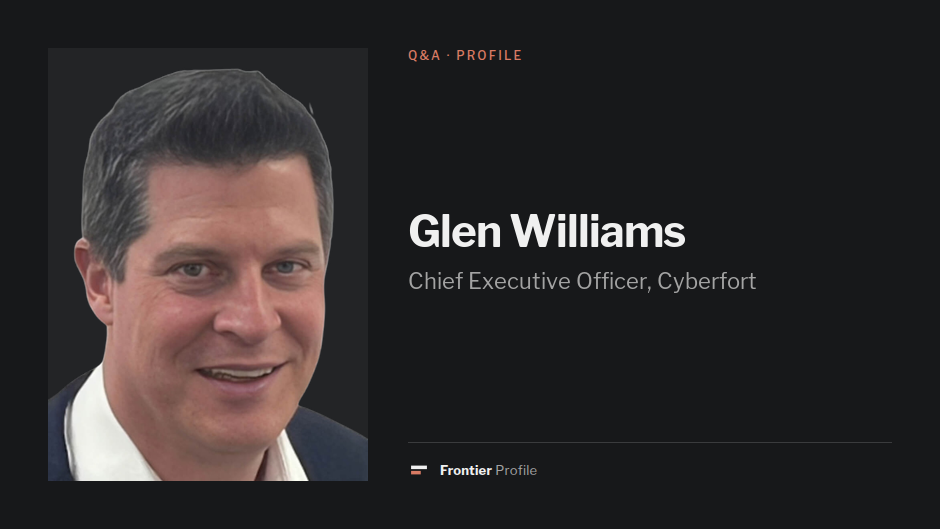
Glen Williams is Chief Executive Officer of Cyberfort, a UK cybersecurity business bringing together consultancy, security testing, managed security and secure cloud services. With a background leading technology businesses including North, Damovo, Dell, Computacenter and Lenovo, Glen brings a practical lens to AI adoption – focused on productivity gains whilst managing the security and commercial risks that come with enterprise deployment.
My questions are in bold - over to you Glen:
Who are you and what's your background?
I'm Glen Williams, CEO of Cyberfort. My background is in leading technology businesses. Before joining Cyberfort, I was CEO of North and Damovo, and earlier in my career I held senior leadership roles at Dell, Computacenter and Lenovo.
That background shapes how I look at AI. I'm interested in what it helps a business do. Can we take time out of an administrative task, help someone work more effectively or improve the service a customer receives?
I use AI a lot in my personal life, so I can see the opportunities. Leading a cybersecurity business also means I have to look very carefully at the risk. You need to understand both sides to make sensible decisions.
What is your job title and what are your general responsibilities?
As the CEO at Cyberfort, I lead the business, set its direction and work with our leadership team on growth, service delivery and key customer relationships. That includes growing the business organically and through acquisitions.
Can you give us an overview of your business?
Cyberfort is a UK cybersecurity business bringing together consultancy, security testing, managed security and secure cloud services. We help organisations understand their exposure, improve their defences and build resilience. Our business model combines professional services projects with ongoing managed services.
What problem do you solve with AI?
The immediate problem is the amount of time people spend on work that supports their job rather than the work where their expertise adds most value. Administration, preparing material for bids and researching prospective customers can all consume a lot of time. Our first use of AI has been focused on internal use and been used to reduce that effort so we can improve productivity and scale more efficiently.
There is a second problem, which is particularly relevant to our industry. People want the experience they get from AI at home, but they need to use it safely at work. Simply opening everything up is not an option when you handle sensitive information. We have built our internal approach around that balance, giving people useful capabilities while applying tighter controls where the work or data requires them.
We started with operational efficiency. Integrating AI more deeply into our core propositions is the next step, rather than something I would claim we have already completed.
What does the AI actually do, and how is it built?
We have built an internal AI capability that draws on existing models and providers. We are not trying to create a new foundation model. For less sensitive work, our internal assistant can select between providers according to the task and the cost of answering it. That lets us remain technology agnostic rather than tie everything to one model.
A practical example is a salesperson researching a group of target accounts. The assistant can help them understand those businesses, identify their priorities and develop a presentation using Cyberfort material already in the public domain. It takes some of the preparation out of the process, but the salesperson still has to check it and apply their judgement.
We take a more contained approach to sensitive work. There are controls over what information can be used and how requests are handled. The principle is that the convenience of getting an answer must not override the protection of our own or our customers' information.
Who are your target customers, and what's your revenue model?
Our sweet spot is the mid-market and upper mid-market, although we also work with large enterprises and public sector organisations. Employee numbers only tell you part of the story. What matters is the complexity of the technology environment and how much the organisation depends on it. A relatively small business can have a very significant cybersecurity requirement.
We generate revenue through professional services and managed services. That includes consultancy, compliance projects and penetration testing, alongside recurring services.
I don't see AI fundamentally changing that model. As we embed it into services, the opportunity is to deliver more efficiently and improve the economics of delivery. I see it becoming part of how we provide those services rather than automatically becoming a separate product with a separate charge.
What's the evidence it works, and what have you learned along the way?
The clearest evidence so far is the time we are saving internally. Our marketing team, for example, can turn work around much faster than before. We are seeing a practical improvement in speed, although I would distinguish that from a formally measured customer outcome or an audited return on investment.
The biggest lesson is that using AI well is a skill. Giving two people the same tool does not mean they will get the same result. You have to be curious, ask good questions and interrogate the answer. I tend to build question on question, coming at something from different directions until I have worked through it properly.
If you ask a question just to get the answer you already want, you can end up reinforcing your assumptions. The value comes from being willing to challenge the output. Human oversight remains essential, even where AI has done a large part of the initial work.
How do you handle the data question?
Our starting point is that sensitive customer information must stay within our controlled environment. We cannot treat it as material to put into an unrestricted public AI service. That requirement is one of the reasons we built our own internal capability.
We distinguish between work using public information and work involving sensitive company or customer data. The latter needs a more contained environment, with controls over access and what can be passed to external services. Protecting that information from use in external model training is part of the requirement.
For a regulated organisation, the questions need to be specific: what data is being used, where is it processed, who can access it and what does the provider do with it? You need an AI policy, staff training and controls that reflect your obligations. An enterprise licence is a starting point for that assessment; you still have to understand the actual service and the risks involved.
What's new at the company, and what's coming next?
The next stage is to build on the internal efficiencies and bring more AI capability into the services we deliver. We are looking at where it can make a useful difference and where the security implications mean we need to proceed carefully.
In our security operations centre, we have already automated first-line analysis using automation and machine learning. Machine learning is a form of AI, but I distinguish that existing capability from the newer generative and agentic AI approaches we are exploring. The next step is to consider a broader range of tasks, with the right human oversight.
We also have further service developments coming. I would rather judge a new service by the problem it solves than by whether we can put an AI label on it. AI may become part of its development, but it should earn its place through the value it adds.
If you had a magic wand, what one thing would you change about how AI gets bought and deployed?
I would make the cost more predictable. AI can be very easy to start using, then the bill grows as people discover more things they can do with it. At enterprise scale, a small cost per task can become a significant expense.
I would like clearer commercial models that let a business plan its spending as adoption increases. I understand why consumption matters to providers: more usage requires more computing power. I don't pretend there is a simple answer, but buyers need a much clearer view of what widespread use will cost.
There is a security consequence too. If the approved option becomes expensive, people may be tempted to find a cheaper or free alternative. That decision needs to involve more than price. Otherwise, a cost problem can quickly become a data and governance problem.
What's your message for the large enterprises evaluating AI right now?
Enable people to use AI, but do it deliberately. People are already using these tools at home and seeing the benefits. They will come into work and ask why they cannot do the same there. We saw a similar pattern with the consumerisation of IT and people wanting to use their own devices.
Start with a clear use case, assess the data and security risks, train your staff and put a workable policy in place. Understand the commercial model as well, including what happens when usage grows. Your security team or partner needs to be involved from the start.
You do not necessarily need to build what we have built. We chose our approach because we are technology agnostic and wanted to manage cost and control. If your organisation is built around Microsoft or Google, an appropriate enterprise service may make sense, subject to your own assessment.
The aim is to improve productivity while managing the risk. If your policy makes useful work impossible, you need to look again at how you enable it safely.
Can you list three people you rate from the AI sector that we should be following on LinkedIn, and why?
Andrew Ng is a useful voice on the practical development of AI and the skills needed to build applications. His educational work is a good starting point for understanding what the technology can do.
Ethan Mollick is useful on how AI changes work and learning. His focus on experimentation and examining what tools actually do fits the questions businesses should be asking about productivity.
Rob Vann, our Chief Solutions Officer at Cyberfort, has been one of the driving forces behind how we are putting AI to work across the business. He combines a deep understanding of cybersecurity with a practical focus on where AI can improve productivity and services, while keeping the risks under control. He is worth following for that perspective on how businesses can adopt AI securely.
What AI tools do you personally use day to day?
The two I use most are Microsoft Copilot and Google Gemini. The reason is fairly straightforward: I already use Microsoft and Google for other tasks, so those tools fit naturally into how I work.
I use AI a lot personally, and I tend to work through a subject by asking follow-up questions rather than taking the first answer at face value. That is where it becomes useful for me: exploring something, challenging it and refining the answer. At work, the controls we need as a cybersecurity business determine what I can use and what information I can put into it.
What's the best new AI product or service you've seen recently?
I haven't got a particular new standalone product that I would single out. What interests me more is how AI is being embedded into products and services people already use, taking effort out of a task and improving the result.
That is how I tend to judge it: what does it let someone do more effectively, and what risk or cost does it introduce? An AI label on its own doesn't tell you whether something is useful. Copilot and Gemini are the tools I use myself, rather than a new product I would claim to have tried.
Finally, let's talk predictions. What trends do you think are going to define AI over the next year or so?
The defining issue will be the balance between productivity and risk. People will want to move quickly because they can see what AI helps them do. At the same time, security teams, regulators and business leaders will want to understand the consequences and put appropriate controls in place.
That tension exists at a national level and inside individual companies. I don't think either side simply wins. The useful outcome is a balance that allows adoption while keeping the risks manageable.
I also expect more pressure from employees who already use AI in their personal lives. Businesses will have to find ways to give them that capability at work. As systems become more capable and take on more tasks, the assessment cannot be a one-off exercise. Organisations will have to keep reviewing what the tools can do, what they cost and what level of oversight they need.
The question for me remains the same: are we getting enough practical value, and are we managing the risk that comes with it?
Many thanks to Glen for taking the time to share his insights with Frontier Profile. You can learn more about Cyberfort on their website.