Varqa Abyaneh, Founder and CEO, Opetek
Varqa Abyaneh on building trusted AI systems that tackle complex quantitative reasoning in financial markets, starting with FX options trading.
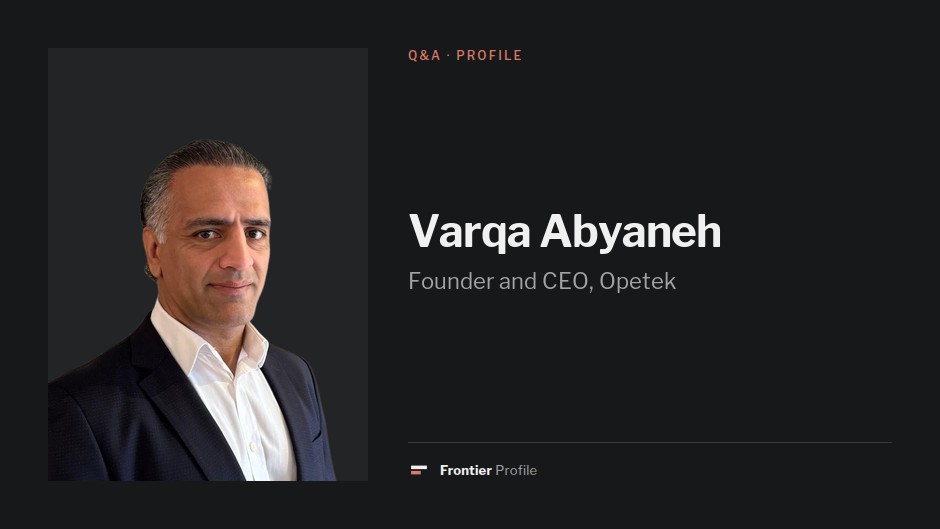
Varqa Abyaneh is Founder and CEO of Opetek, a company building trusted AI systems that help financial institutions make better, faster and more defensible decisions. With a background spanning theoretical physics, quantitative finance and technology leadership at HSBC, Morgan Stanley and Quantile, Varqa brings a first-principles approach to one of AI's central challenges: how to reason reliably through complex quantitative problems. Opetek's first product, ARIUS, launched in 2026 and is already live with Tier 1 global investment banks.
My questions are in bold - over to you Varqa:
Who are you and what's your background?
I'm Varqa Abyaneh, Founder and CEO of Opetek. I did my Masters in Mathematics at Cambridge before completing a PhD in Theoretical Physics at York and undertaking postdoctoral research in quantum mechanics.
I originally moved into finance for fairly pragmatic reasons. I wanted to build the financial independence to pursue my own scientific and entrepreneurial ideas. But once I started working in financial markets, I discovered a world of fascinating mathematical and computational problems, and ended up spending much of my career across derivatives trading, quantitative analysis and technology, including roles at HSBC and Morgan Stanley.
Before founding Opetek, I was Chief Product Officer at Quantile, where I helped pioneer several optimisation products now used by major financial institutions. Optimisation is also a foundational discipline in AI, so that experience provided a strong technical foundation for building Opetek. Equally importantly, I had the opportunity to work with and learn from some exceptional people as we grew Quantile from an early-stage startup through to its acquisition by London Stock Exchange Group.
My background in physics shaped how I approach problems. Modelling complex systems, reasoning from first principles to identify the key drivers, breaking difficult questions into structured steps and rigorously testing conclusions are all fundamental to how I've been trained to think. That same approach to problem-solving now underpins the culture we're building at Opetek.
I've always been drawn to fundamental problems. Strip finance back to its foundations and you arrive at two questions: what should you trade, and who should you trade with? Almost every role, system and process in financial markets exists, directly or indirectly, to support these decisions.
I founded Opetek to tackle these questions by addressing one of the central challenges in AI: how to reason reliably through complex quantitative problems.
What is your job title and what are your general responsibilities?
As Founder and CEO, my responsibility is both to set the vision for Opetek and to build the company capable of delivering it.
I think of the founder's journey as moving from defining a vision, to building a product that people really need, to growing a company that can deliver and scale that product. Each stage requires a different set of skills.
I approach building a company much like solving a complex problem in physics. Breaking it down into its fundamental components, understanding how they fit together and finding exceptional people to take ownership of each part.
Day to day, my job is to keep things moving forward, whether that's working with clients, shaping product strategy, supporting the team or discovering that negotiating an office lease can be more complicated than some of the mathematical problems we work on.
As Opetek grows, an increasingly important part of my role is building a strong leadership team, delegating responsibility and giving people the autonomy to make decisions. Ultimately, I want to build an organisation where exceptional people have the autonomy, responsibility and support to do their best work.
Can you give us an overview of your business?
Opetek builds trusted AI systems that help financial institutions make better, faster and more defensible decisions.
Our first product, ARIUS, is Opetek's AI reasoning platform, launched in 2026. It combines deep financial markets knowledge with a proprietary AI reasoning architecture to help trading desks investigate complex quantitative problems.
We're starting with FX options, one of the more sophisticated areas of financial markets. A trader investigating a market opportunity might need to move between several systems, gather data, run pricing models, analyse news and write bespoke code. That process can take considerable time, and in financial markets, the value of a decision often depends on how quickly you can reach it.
ARIUS brings these capabilities together, reasoning across market data, quantitative models and qualitative information. Its architecture is designed to tackle problems involving datasets that extend beyond the context window of conventional language models, while producing auditable code, transparent reasoning and reproducible results.
The distinction is important. We're not simply building AI that generates plausible answers. We're building systems that can work through complex financial problems using appropriate models, calculations and evidence, so professionals can interrogate and verify the conclusions.
Our initial focus is institutional trading desks, with the ambition of extending these capabilities across capital markets.
What problem do you solve with AI?
At its heart, we're providing decision analysis to help traders investigate one of the most fundamental questions in finance. What should you trade?
It's a deceptively simple question. In practice, investigating it requires bringing together enormous amounts of information, applying sophisticated quantitative models and making judgements under considerable time pressure.
We see four main sources of decision friction.
The first is fragmented workflows. The information needed to investigate a trading opportunity is often spread across market data systems, pricing models, research and internal communications.
The second is cognitive overload. Financial markets generate enormous volumes of information, far more than any individual can reasonably process. Even conventional AI systems face limitations because the volume of data required for an analysis can exceed the number of tokens available within their reasoning context.
The third is analytical delay. Answering a new question can require bespoke coding, data preparation, model setup and repeated analysis, often taking valuable time when markets are moving.
And the fourth is limited traceability. The assumptions, calculations and reasoning behind a decision aren't always captured in a way that can be inspected or reproduced.
ARIUS is designed to overcome these sources of decision friction by bringing information, quantitative analysis and AI reasoning into a unified, auditable workflow.
Our aim isn't to replace the trader's judgement or recommend what to trade. It's to provide the decision analysis that allows traders to investigate more questions, reach analytical conclusions faster and make better-informed, more defensible decisions.
What does the AI actually do, and how is it built?
Consider an FX options trader investigating whether an option looks expensive or cheap relative to its historical behaviour, and how that valuation changes around major economic announcements.
They might ask ARIUS to analyse 15 years of FX options market data, compare current valuations with historical distributions, and examine how those valuations behaved around inflation announcements or central bank decisions.
This involves more than retrieving information. The system needs to perform quantitative analysis across a substantial historical dataset, relate the results to economic events and bring those findings together into a coherent assessment.
The challenge is that 15 years of detailed market data can contain far more information than a conventional large language model can hold in its context window. Trying to load all that data into the model isn't practical, and even where it is possible, it can be prohibitively expensive.
Our approach starts from a simple principle: computation is relatively cheap, but AI reasoning is expensive. So we've designed ARIUS's proprietary architecture to separate the two. Rather than bringing all the data into the LLM's context window, the AI reasons about the problem, determines which analyses are needed and uses specialised quantitative tools to perform computations directly on the underlying datasets.
The results are then brought back into the reasoning process, allowing ARIUS to combine quantitative findings with economic context and investigate questions involving datasets far larger than an LLM could process directly.
Importantly, the system produces auditable code, transparent reasoning and reproducible calculations. Traders can inspect the analysis, understand the assumptions and apply their own judgement to any trading decision.
We build our proprietary reasoning architecture around existing foundation models rather than training a general-purpose LLM from scratch. The architecture is model-agnostic, allowing us to combine different AI models with specialised financial tools and conventional quantitative computation.
Who are your target customers, and what's your revenue model?
Our customers are institutional financial firms, particularly investment banks and trading businesses operating in complex markets.
We're starting in FX, where sophisticated quantitative analysis and human judgement are central to the trading process, often under significant time pressure. Our ambition is to extend ARIUS across asset classes, including equities, fixed income, commodities and credit.
Traders often have far more ideas and hypotheses than they have time to investigate. Many potentially valuable questions simply go unexplored because testing them requires too much data preparation, coding and quantitative analysis.
ARIUS changes that. It allows traders to investigate ideas they would otherwise never have had time to explore, opening up new possibilities for market analysis.
It also improves the quality of analysis. Under time pressure, traders may need to make simplifying assumptions or restrict the scope of an investigation. ARIUS makes more thorough analysis practical, while freeing traders to focus on framing problems, challenging assumptions and exercising judgement rather than working through the mechanics of producing an answer.
We're already live with a Tier 1 global investment bank and conducting pilots with other major financial institutions.
Our revenue model is based on software licensing. We offer institutional licensing arrangements tailored to the scale and requirements of individual trading desks.
What's the evidence it works, and what have you learned along the way?
The most important evidence comes from seeing ARIUS used by traders and quantitative analysts at major financial institutions, and from the feedback we're receiving as they apply it to real market problems.
We work closely with our clients to understand where ARIUS delivers the most value and what capabilities they need next. The range of potential applications is extensive, and while our roadmap is ambitious, the direction of travel is clear. Client feedback plays a central role in determining our development priorities.
On the technical side, we've learned that conventional approaches to AI aren't always sufficient for complex quantitative problems.
First, standard LLM architectures aren't well suited to reasoning directly over very large datasets. The amount of information required can exceed a model's context window, and attempting to process everything through the model is both inefficient and expensive.
Second, conventional approaches to explaining AI reasoning aren't sufficient for highly quantitative problems. A plausible written explanation isn't enough. Users need to inspect the underlying calculations, assumptions and code, and be able to reproduce the results.
These challenges have shaped the development of our proprietary reasoning architecture, which separates AI reasoning from conventional computation and makes auditability a fundamental part of the analytical process.
Perhaps the most interesting observation is that these challenges aren't unique to financial markets. They arise wherever AI needs to reason reliably across large datasets and complex quantitative models, whether in science, engineering or other quantitative disciplines.
Finance is where we're applying our technology first, but the fundamental problems we're solving have much broader applications.
How do you handle the data question?
Data security is fundamental when working with financial institutions, particularly when dealing with sensitive trading information and proprietary models.
We've built ARIUS with security and encryption controls designed to meet the standards expected by major financial institutions.
An important distinction is between our standard product and bespoke enterprise integrations. Standard ARIUS operates in a secure cloud environment using Opetek's own analytics and quantitative models, with market data currently sourced from Refinitiv. Our architecture is data-agnostic, so we can integrate other data providers where required.
This means institutions can use ARIUS without needing to connect their proprietary datasets or internal systems. In its standard configuration, ARIUS primarily processes users' questions and analytical interactions, rather than accessing the institution's underlying trading data. This substantially simplifies deployment and security assessment, although we recognise that even questions can contain sensitive information.
For institutions that want ARIUS to reason over their own proprietary data and models, we also support bespoke integrations. These require more extensive security, data governance and integration work, which we undertake in collaboration with the institution.
Auditability is equally important. Users can inspect the data, calculations and assumptions behind an analysis, which is particularly valuable in a regulated environment.
What's new at the company, and what's coming next?
We launched ARIUS in July 2026 and are now working with major financial institutions to develop its capabilities within real trading workflows.
Our roadmap has four main areas of focus.
The first is reasoning across increasingly large and granular datasets. We're extending ARIUS's ability to analyse long periods of intraday market data, allowing traders to investigate historical patterns and market behaviour at a much greater level of detail.
The second is deeper quantitative reasoning. Our ambition is for ARIUS to sustain increasingly complex, multi-stage investigations, making multiple analytical steps and tool calls while maintaining auditable code and reproducible results throughout. This also creates the foundation for ARIUS to revisit and refine its own methods, with specialised AI agents helping to examine and improve different parts of an analysis.
The third is cross-asset reasoning. We're starting in FX, but the same underlying technology can be applied across equities, fixed income, commodities and credit. Ultimately, we want ARIUS to reason across asset classes rather than treating each market in isolation.
Finally, we're expanding how ARIUS integrates into institutional workflows, through APIs, existing collaboration platforms such as Microsoft Teams, and the ability to participate as a specialised quantitative reasoning agent within broader multi-agent systems. Further possible enhancements include integration with execution platforms.
The common theme is moving from answering individual quantitative questions towards conducting deeper, more comprehensive investigations that fit naturally into how financial institutions work.
If you had a magic wand, what one thing would you change about how AI gets bought and deployed?
I'd like the industry to slow down just enough to think more deeply about the architectural decisions it's making.
AI is a relatively new field, and the technology is evolving at an extraordinary pace. But because there's such intense competition to adopt it, organisations are often quick to embrace emerging standards, protocols and architectures without sufficiently questioning the assumptions behind them.
I think this is an area that would benefit enormously from first-principles thinking. What problem are we actually trying to solve? What should AI be responsible for? Which capabilities should remain independent of any particular model, provider or technology?
The risk is that organisations build themselves into architectures that become increasingly difficult to adapt or replace as the technology evolves. Decisions that seem expedient today could become significant constraints tomorrow.
At Opetek, we've tried to approach this differently. Starting with the fundamental problem of quantitative reasoning and designing the architecture around what that problem actually requires, rather than simply adopting whatever approach happens to be fashionable.
My concern isn't that the industry is moving too quickly. It's that we sometimes confuse moving quickly with thinking carefully. The two shouldn't be mutually exclusive.
What's your message for the large enterprises evaluating AI right now?
My advice would be to experiment boldly, but choose your technology partners carefully.
AI is evolving so rapidly that no one can be certain which models, architectures or standards will dominate in a few years. That shouldn't stop organisations from experimenting. You'll learn far more from testing a credible solution against a real business problem than from watching demonstrations or following industry commentary.
But don't confuse a successful proof of concept with a useful product. Building an impressive AI demonstration is relatively easy. Building something professionals trust enough to use repeatedly in a real workflow, particularly where decisions have financial or regulatory consequences, is considerably harder.
I would also pay close attention to the quality of the people behind the technology. Do they understand the problem deeply? Can they explain why they've made particular architectural choices? Are they willing to challenge their own assumptions?
Ultimately, you're not just buying software. You're choosing a team whose judgement and ability to adapt may matter as much as the technology they've built today.
Can you list three people you rate from the AI sector that we should be following on LinkedIn, and why?
I tend to follow ideas rather than personalities. I'm interested in people approaching AI from different perspectives, whether through scientific discovery, mathematical foundations or building ambitious technology companies.
His work at Google DeepMind, particularly the application of AI to scientific discovery that contributed to his Nobel Prize in Chemistry, is fascinating. I respect the combination of scientific rigour and ambition to tackle fundamental problems.
2. Bob Coecke
A physicist and computer scientist who co-developed ZX-calculus. He was also Chief Scientist at Quantinuum. From our conversations, I've particularly appreciated his willingness to challenge conventional thinking and approach difficult problems from entirely new directions.
What AI tools do you personally use day to day?
I use the interfaces of the major AI providers regularly, both for everyday work and to keep track of how their capabilities are evolving.
At Opetek, though, our most interesting use of AI goes beyond these interfaces. We build proprietary reasoning architectures that combine foundation models with specialised tools and conventional computation to solve complex quantitative problems.
I'm less attached to any particular AI product than to finding the right combination of technologies for the problem at hand. The models are improving rapidly, so we deliberately design our systems to remain flexible as the technology evolves.
What's the best new AI product or service you've seen recently?
I've been particularly impressed by the emergence of AI coding agents, especially Claude Code and OpenAI Codex.
What interests me isn't simply their ability to write code, but their ability to work through multi-step problems, use tools, test their own outputs and iterate. I think they offer an early glimpse of how AI will evolve from answering questions to carrying out increasingly complex work.
Finally, let's talk predictions. What trends do you think are going to define AI over the next year or so?
I think the defining shift will be from AI systems that generate answers towards systems capable of investigating problems, using tools and producing verifiable conclusions. Beyond that immediate evolution, there are two developments I find particularly fascinating.
The first is embodied AI, such as giving AI the ability to interact with and learn directly from the physical world.
Much of today's AI has learned from information humans have already produced, whether text, images or other digital content. But what happens when AI can learn directly from nature?
Imagine giving an AI a physical body, a ruler and a clock, and allowing it to experiment with the world around it. How long would it take to independently discover Newton's laws of motion? It took humanity centuries to develop that understanding. Could an AI arrive at the same conclusions much faster?
To me, that's fascinating. AI moving beyond learning from human knowledge towards generating new knowledge through direct observation, experimentation and reasoning, of the real physical world.
The second is the question of objectives and purpose.
As AI systems become increasingly capable of acting autonomously, learning from experience and improving their own methods, I think we'll need to examine much more carefully what objectives we give them and how those objectives are defined.
An AI system can become extraordinarily effective at optimising for a particular goal. But how do we ensure it's pursuing the right goal? Can principles and constraints provide a more robust foundation than a narrowly specified objective function? And what happens when a system encounters situations its designers never anticipated?
These questions sit at the intersection of computer science, philosophy and engineering. I suspect they'll become increasingly important as AI moves from being a tool that responds to instructions towards systems capable of more independent action.
Many thanks to Varqa for taking the time to share his insights with Frontier Profile. You can learn more about Opetek on their website.