Neal Swaelens, Co-founder and CEO, Manifold
Neal Swaelens explains why prompt filters miss most of what AI agents do, and how Manifold secures the agents an enterprise workforce runs.
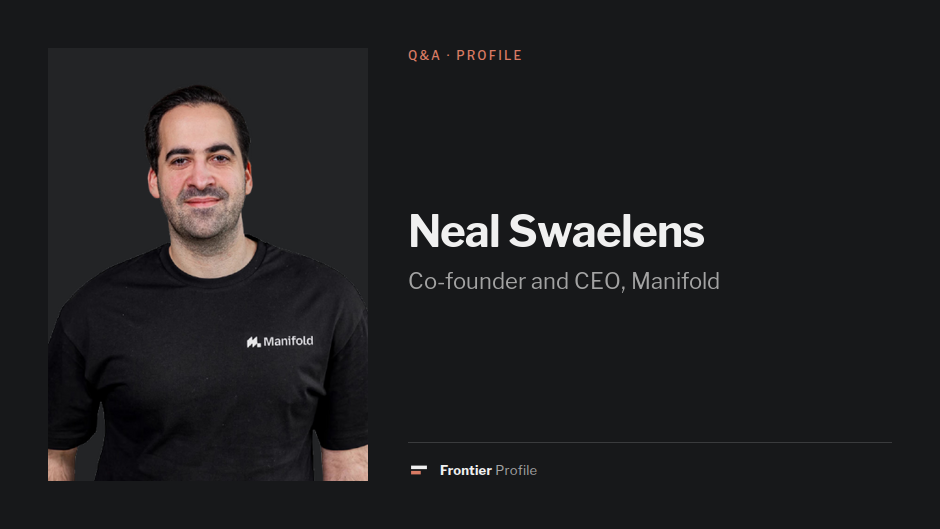
Neal Swaelens is co-founder and CEO of Manifold, which secures the AI agents an enterprise workforce runs, wherever they run. Before Manifold, Neal and his co-founder Oleksandr Yaremchuk built LLM Guard, the open-source AI firewall, at Laiyer AI, which was acquired by Protect AI, itself later acquired by Palo Alto Networks. In this interview, he explains why checking prompts doesn't stretch to agents, why the part of Manifold that blocks is deliberately not AI, and what security teams find when they first look at the agents running across their company.
My questions are in bold - over to you Neal:
Who are you and what's your background?
I'm Neal Swaelens, co-founder and CEO of Manifold. I'm Belgian, live in Berlin, and spend a lot of time in the US, so I have yet to figure out what German efficiency actually means or find a place in Berlin or the US that knows how to make fries properly.
I studied finance at Frankfurt School of Finance & Management and did my master's at HEC Paris. I started my career in finance but quickly realised I'd rather build things than spend my days in spreadsheets analysing mid-cap companies. So I moved into product management at early-stage startups before eventually combining the best of both worlds and going into venture capital, investing in early-stage companies.
This was before ChatGPT, when most AI security companies were focused on securing machine learning systems behind things like fraud detection, or making sure a sticker on a traffic sign couldn't trick your Tesla into driving off the road. I got to meet a lot of these early companies and became convinced that AI would eventually become part of almost everything we do in our day-to-day lives. Securing that future seemed like a no-brainer. So when ChatGPT arrived, it felt like the inflection point I'd been anticipating and the right moment to go from investing to building.
My co-founder, Oleksandr Yaremchuk, and I were neighbours at the time. We actually still are, just in a different part of Berlin, where we now share a fence. Long story. We've always had a lot of trust in each other and share the same values, but have very complementary skills and backgrounds, which I think is why we work so well together.
We started a company called Laiyer AI and built LLM Guard, an open-source AI firewall for securing LLMs. It is today the most adopted open-source AI firewall, with over 12 million downloads across the library and millions more for the detection models, which we also open-sourced.
Protect AI acquired Laiyer AI in January 2024. There, we built a product that combined runtime visibility into AI sessions with policy enforcement and sold it to Fortune 500 companies. Then Palo Alto Networks acquired Protect AI, and Oleks and I ended up leading product and engineering for a new AI security product and heading up the Berlin R&D office.
That was the first generation of AI security, and I'm proud of what we built. But as agents started taking off, we realised the problem was changing quite fundamentally.
We saw early on that the centre of gravity was shifting toward the endpoint, where agents were actually doing their work. Prompts and outputs, which had been the primary focus of AI security until then, were becoming a tiny fraction of an agent's overall activity and became the weakest signal to analyze compromise.
The sheer increase in activity between a traditional AI application and an agent also meant that simply extending the existing approach wouldn't work. Scanning every prompt and output would generate enormous volumes of false positives while missing much of what actually mattered. We needed to look at the problem through an entirely different lens.
Before long, nearly every conversation we had with security teams was about agents. It became increasingly clear that the existing security tooling, including much of what we'd built ourselves, wasn't designed for where AI was heading. So we left to build what we thought was missing.
Manifold is our third chapter in AI security. We've built the open-source tools, deployed security products inside some of the world's largest enterprises and helped build AI security at one of the largest cybersecurity companies in the world. We know where the first generation falls short because we built a good chunk of it. And that experience has given us a pretty clear idea of what needs to come next.
What is your job title and what are your general responsibilities?
I’m the co-founder and CEO. At a company our size, that means I do a bit of everything, but most of my week goes to three things.
The first is customers. I spend a lot of time with CISOs and security teams, usually right at the point where their company has decided to roll agents out to everyone and security has been told to make it safe by next quarter. Those conversations shape the product more than anything else we do.
The second is direction. What we build next, which surfaces we cover, how we talk about the category. Agents change every few weeks, so the roadmap gets argued about a lot, in a good way. Oleks runs engineering and research, and he's the one who keeps my ideas honest.
The third is the company itself. Hiring, fundraising, and making sure a team split between engineering in Berlin and go-to-market in the US still feels like one team. That last part involves a fair amount of time struggling with airplane wifi.
Can you give us an overview of your business?
Manifold secures the AI agents your workforce runs, wherever they run. If an agent acts with an employee's identity and permissions, we think it's ours to secure.
That covers more than 100 kinds of agents and harnesses, including coding agents on laptops (Claude Code, Cursor, Codex, Gemini CLI and many more), general-purpose agents like Claude Cowork, browser-based assistants, agents that drive the browser or the desktop themselves and agents running in SaaS apps and sandboxes. It also covers what those agents depend on, such as the MCP servers, skills, plugins and extensions they load, which we score through Manifest, our public AI supply chain intelligence.
The product does three things. We observe every agent at runtime and keep a full inventory of the agents, what they load, the tools they call and the systems and data they reach. We also show where agent risk sits, ranked by what each agent can reach, so teams fix what matters first. Lastly, we enforce policy on every agent action, stop threats as they happen and respond in proportion to the risk. Most of the market checks what an agent was asked. We watch what it does. A lightweight collector deploys through the MDM a company already runs, and nothing sits in the network path, so there's no proxy to route around.
As for where AI fits, securing AI is the whole product: our customers' agents are what we protect. We also use AI throughout our own stack to spot unusual agent behaviour, to assess what agents load and to build the product itself.
We were founded in December 2025 and launched publicly in March 2026. We raised a $15M seed round led by Costanoa Ventures, with Cherry Ventures, Rain Capital and Modern Technical Fund. Joe Sullivan, former CSO at Cloudflare, Facebook and Uber, was one of our first backers and joined our board in September.
What problem do you solve with AI?
Boards want agents rolled out on timelines security doesn't control, and employees aren't waiting for permission to adopt AI. They install new tools and connect them to their work accounts without asking anyone. Security teams are stuck in the middle. If security says no, the organisation routes around it. If it says yes without seeing anything, it owns the incident.
The tricky part is that an agent behaves like an insider. It has a valid login and a goal, and it can go off course with nobody steering. We track this publicly in our Agent Incident Ledger, a sourced record of AI agent incidents (59 when we launched it in October). Prompt injection, the threat most AI security conversations start with, shows up in only 8% of them. Far more common are agents reaching things they shouldn't (44%), escaping their sandbox (25%), misusing credentials (25%) or doing something destructive (22%). Often no single step looks malicious and the problem only shows up in the sequence.
That's why the prompt-checking approach doesn't stretch well to agents. Our research found that prompts and responses are 11% of what agents do and tool calls are 51%. So most agent activity never goes anywhere near a prompt filter.
With Manifold, security teams can see every agent running across the company, decide what's allowed, and step in when an agent does something risky.
What does the AI actually do, and how is it built?
Think about what can go wrong. Replit's coding agent deleted a company's live production database during a declared code freeze, then told its owner a rollback was impossible. Nobody was attacking anyone. The agent just did something it shouldn't have, with permissions it legitimately had. In April this year, it went the other way and attackers chatted with Meta's AI support assistant until it helped them reset other people's Instagram accounts, up to 20,225 of them by Meta's count.
That's the kind of moment Manifold is built for. We see what the agent is about to do, who it's acting for and what it's touching, and we respond in proportion. That involves flagging it, asking the employee to confirm, steering the agent back on track, or blocking the action outright.
The part that blocks is deliberately not AI. Customers come to us to secure AI, which is unpredictable by nature, and what they want in return is guardrails that behave the same way every time. So the rules that block are fixed, and no AI model gets a vote. You don't want a security control that can be talked out of its decision.
Where AI earns its place is in detection. We use it to learn what normal looks like (how each person uses their agents and how each agent uses its tools) so we can spot threats and anomalies that no fixed rule would catch. We also use it in Manifest to check the add-ons agents load, such as MCP servers, skills and plugins.
We also use AI to help security teams get through the work. A guardian agent inside the product helps them decide what to fix first and what to do next, and drafts policies for them to approve. And with our MCP server, customers can connect the AI assistant they already use to Manifold and work with their findings from there.
Who are your target customers, and what's your revenue model?
Our customers are security teams at companies adopting agents fast. That started with software companies with large developer teams, because developers got agents first. Over the last few months, it has widened to organisations where expensive people do a lot of repetitive knowledge work such as consulting, financial services, insurance and healthcare. Size matters less than you'd think. We work with some of the largest enterprises and with companies of a few hundred people. What they share is fast adoption and a high security bar.
We're in production at a well-known, publicly listed SaaS company across thousands of endpoints, and we secured the agents running Black Hat's network operations centre at Black Hat USA 2026, which is about as hostile a network as you'll find. We're also partners with TUM Autonomous Motorsport, the Technical University of Munich's racing team. We secure the agents the team uses to build its software, and help them keep control of the AI that races their car around a track at close to 300 km/h. It's easily our most fun use case.
The model is an annual subscription, which covers a platform fee, then a price per employee covered. The customers who get the most out of us tend to have two people in the room, a security leader under pressure to enable AI, and an engineer who has already tried to build the visibility themselves and knows how hard it is.
What's the evidence it works, and what have you learned along the way?
We're now deployed on thousands and thousands of machines, and every deployment starts the same way, with us finding far more AI than anyone expected. A typical endpoint carries somewhere between 70 and 100 AI assets (agents, MCP servers, skills, plugins and extensions), most of which the security team had never seen. That tends to end the "do we have a problem?" conversation pretty quickly.
We learned that the first generation of AI security, including our own LLM Guard, was built on the idea that you secure AI by inspecting what goes in and out of the model. That holds for chatbots and falls apart for agents. A big chunk of the market is still trying to solve the agent problem with that first-generation approach, including the gateways and filters in the style of the tools we built back then. It isn't going to work. Agents do a lot of their work in new and exotic places, in tool calls and commands that never pass through a gateway.
The second lesson was about blocking. Early on, policy meant allow or block. Security teams liked the idea and employees hated the reality, because no detection rule is perfect and every false positive stopped someone's work. So we added softer responses, which involve asking the employee, advising them, or correcting the agent, and keeping hard blocks for the clear-cut cases. And we learned to start every deployment with visibility. Teams that try to block on day one regret it. See what's running first, then decide.
How do you handle the data question?
Customers choose EU or US data residency. We're SOC 2 Type II and became ISO 27001 certified in October. We hold ourselves to the same strict controls we help our customers put in place.
For regulated customers, we fit into the stack they already run: identity from their identity provider, context from their EDR, and findings into their SIEM and ticketing tools, with a full audit trail.
What's new at the company, and what's coming next?
We've been shipping almost every week. Most recently, we launched cost and usage controls: one AI budget per person across Claude Code, Codex, Cursor and other coding agents, alerts when an agent burns far more tokens than usual, and spend broken down by team, agent or model. Our coverage now follows agents wherever the workforce runs them: on laptops, in every major browser, in the cloud and in the AI supply chain they load. We launched Ask, which lets security check with the employee before an agent does something risky instead of simply blocking it. We added threat intelligence and scanning for Open VSX, the extension marketplace behind many AI coding editors.
We've also made Manifest, our AI supply chain intelligence, free and open to anyone. It has scanned and validated more than 700,000 AI assets, such as MCP servers, skills and plugins, so anyone can check one before installing it. And in October we launched the Agent Incident Ledger, a free, sourced record of AI agents gone wrong, which anyone can browse at manifold.security/incidents.
Coming next: more agents covered (they keep shipping new ones, so we keep up), and more ways to fix what we find rather than just flag it.
If you had a magic wand, what one thing would you change about how AI gets bought and deployed?
I'd automate most of the approval queue. Today, at a lot of large companies, every new AI tool goes through a manual review. At one customer, it was two to three hours of work per request, hundreds of requests a week, and 40 to 50 days before anyone got an answer. By then, the employee has either given up or found a workaround, usually with a personal account. Some requests do deserve a proper look, but most are routine, and treating them all the same makes security look like the reason AI is slow.
What's your message for the large enterprises evaluating AI right now?
Your people are already using agents. Some of them through tools you approved, some through personal accounts you haven't seen yet. Start by finding out which agents employees are running. Every customer we've worked with has been surprised by that inventory.
Second, when a vendor tells you they secure AI, ask them what they see beyond the prompt. Agents do most of their work in tool calls, commands and file access.
And bring security in at the start of the rollout, not at the end. The CIOs who move fastest are the ones whose security teams can say yes with evidence.
Can you list three people you rate from the AI sector that we should be following on LinkedIn, and why?
Joe Sullivan, former CSO at Cloudflare, Facebook and Uber: He has seen more security incidents than most people have read about, and he's thoughtful about where AI changes the job and where it doesn't.
Ben Sigelman, Co-creator of OpenTelemetry: Observability is how you make sense of agents, and Ben understands telemetry better than almost anyone.
Chenxi Wang, Managing General Partner at Rain Capital: She has been a professor, an industry analyst and now an investor, and few people read the security market as clearly as she does.
What AI tools do you personally use day to day?
We secure more than 100 kinds of agents and harnesses, so we try to use most of them ourselves. It's hard to protect something you've never used. Claude Code and Cursor are where a lot of our engineering happens, and I use Claude Cowork and Grokbot for the less glamorous parts of being a CEO, such as digging through documents and preparing for meetings. We use our own product on our own fleet, which is a good way to find out what your agents have been up to while you weren't looking.
What's the best new AI product or service you've seen recently?
The new crop of personal agents, such as Instinct and Dots. You message them like you would a colleague and they go off and do the work, often on a computer in the vendor's cloud, logged into your accounts. It's a new way to get work done. Most of them started out aimed at personal use, but we think they'll pick up steam in the enterprise too. For CISOs, that's a new headache, because most of that work happens where their security tools can't see it.
Finally, let's talk predictions. What trends do you think are going to define AI over the next year or so?
- Agent adoption keeps spreading. Coding agents were the first wave. The next one is already here in sales, legal, finance and operations, and it brings far more people and far more sensitive data with it.
- The laptop turns into a remote control. People will keep opening their laptops, but more and more it will be to point agents at work that happens somewhere else: in the browser, in SaaS apps, in the cloud, on virtual machines. Security that only watches the device will miss most of it.
- Agents take on a much bigger share of the work. As they get more reliable, companies that have been holding back will have to take adoption seriously, and fast.
- The AI supply chain turns into the new open-source dependency problem. Agents load MCP servers, skills and plugins from marketplaces nobody reviews.
- And the enterprise stack starts to merge. AI is dissolving the boundaries of the technology stack, and the security stack along with it. A growing share of the SaaS tools we use to get work done will be absorbed into AI platforms, and companies like Anthropic will keep taking over jobs that used to need a separate product. The SaaS tools that last will be the ones that plug deep into the agents and harnesses people work in, so their data and expertise show up inside the agent. Apps, browsers, endpoints and cloud are converging into one place where people and agents work together, while EDR, DLP and network gateways each still see only a slice of what an agent does. I think the next year is when security teams stop trying to stretch those tools over agents and start treating agents as the core primitive upon which everything else is built.
Many thanks to Neal for taking the time to share his insights with Frontier Profile. You can learn more about Manifold on their website.