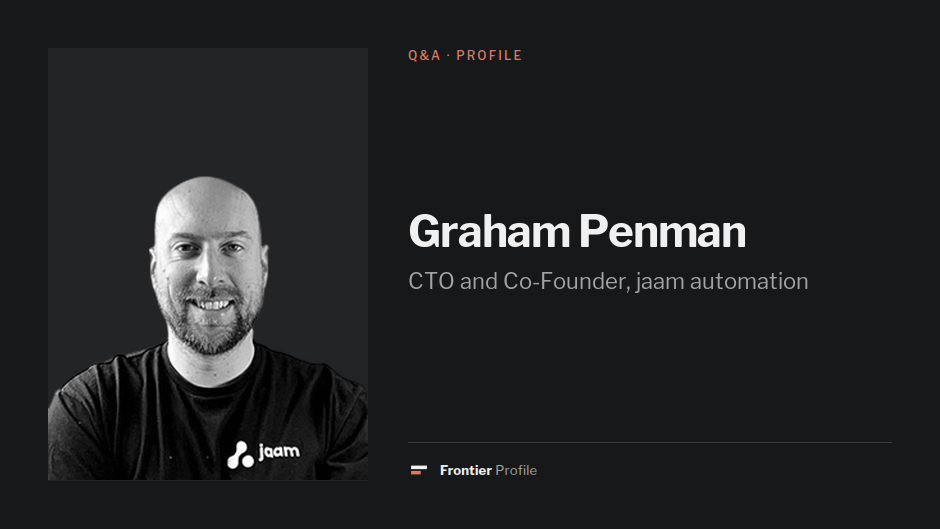
Luke Talbot, Chief Product and Technology Officer, Flip AI
Luke Talbot discusses building an agentic operating system for the 80% of workers who don't sit at a desk, and why frontline employees deserve better software.
Luke Talbot is Chief Product and Technology Officer at Flip AI, where he's on a mission to connect the 80% of the global workforce that doesn't sit at a desk. Having spent over two decades building software for knowledge workers, Luke decided to focus on the frontline - the nurses, warehouse operatives, retail staff and production line workers who've been systematically excluded from the digital infrastructure their desk-based colleagues take for granted. Flip AI raised $25 million in August 2024 and is building what Luke calls an "agentic operating system for the frontline" - a platform that starts from the reality of a personal phone, a few seconds between tasks, and the need for specific answers right now.
My questions are in bold - over to you Luke:
Who are you and what's your background?
My name is Luke Talbot and I grew up on a mountain in the South of France without electricity. That's not actually a joke - I moved there when I was 11, and moved back to the UK in 1997 to study Archaeology at the University in Southampton. While immensely enjoyable, that degree was utterly useless for the career ladder, so I got my Masters in Information Systems in 2002 from Portsmouth University, which got me my first job in tech, working for a small telecoms software company on the south coast of England.
In the 25 years since, I have worked in software development, first in telecoms, then market research, employee engagement, digital adoption platforms, and most recently Flip AI. In that time, we've gone from sending CDs to customers to install in their own server rooms, having phones on our desks, and working in offices every day, to updating production environments continuously in the cloud, having our own mobile phones at work and sitting at home with teams spread across the entire planet.
What brought me to Flip AI was extremely straightforward: the realisation that I had spent 20+ years of my life building software for 20% of the global workforce. The remaining 80% were the silent, ignored, disconnected majority. And while Covid made us clap for frontline workers, I decided to join Flip AI and make it my mission to give them the software they deserve so they could be connected to everything they need at work, and no longer be forgotten.
What is your job title and what are your general responsibilities?
I like to call myself "Chief Builder", but my actual title is CPTO (Chief Product and Technology Officer). I come from a product background with a solid tech perspective, which puts the P first.
The title covers three things that are impossible to separate: what we build, why, and how. On the product side, that means maintaining a clear product vision and strategy. There are a million things we could do, but it's my job to make sure we pick the right ones and swarm on them so we get there fast enough. On the technology side, it means making sure everything we build is scalable, stable and secure. That extends from deciding which frameworks and tools we use all the way through to managing and maintaining our hosting infrastructure and cloud partners.
In the end customers only buy one thing: trust. Trust that if they pick you, your product will solve their problems now and in the future. And trust that if they pay you, you've got this, that the platform will be there when they need it and all their compliance risks will be resolved.
So in a way, as Chief Builder, my job is to build trust.
Can you give us an overview of your business?
Flip AI is an agentic operating system for the frontline, and it starts with a simple problem: 80% of the global workforce is disconnected. You might call them frontline, or blue collar, or deskless, but the problem is the same. It's hard to reach them, harder to engage with them, all of which makes business transformation exceptionally hard for frontline-heavy organisations.
We have a simple product vision for this: connect every employee to everything they need in one touch.
But what started as a communication platform for deskless workers (the kind of platform that replaces a risky store WhatsApp group, breakroom noticeboard and "help us improve!" suggestion box) has turned out to be the visible edge of something much deeper.
The real issue is that frontline workers are systematically excluded from the digital infrastructure that desk workers take for granted. They usually don't have a login to the systems they need, managers have to do it for them. No access to shift plans. Hard to book time off. Even worse, when companies do try to digitalise frontline processes, it introduces even more friction, taking workers away from their patients, customers, production lines etc so they can use shared computers and kiosks. I've heard from nurses and police who literally hate their jobs because they're spending more time coping with poorly adapted systems at a shared desk, rather than doing a job that they used to love. And while their connected-worker counterparts are casually submitting vacation requests while sitting on the sofa watching Netflix, they're waiting till the morning when they can put in a formal request with their manager.
So we built a platform that starts from the frontline worker's reality: a personal phone, a few seconds between tasks, a need for a specific answer right now. The platform covers four key steps: you activate your workforce with Frontline Identity, at last giving them a fit-for-purpose, secure digital identity without requiring a corporate email, clunky authenticator app, or a Microsoft licence. The core app helps you reach and engage everyone with news, chat, voice and video. Fusion is our AI app builder, which lets customers build and ship their own apps on top of the platform without needing engineering resource. Finally Flip AI, which is what truly makes it the agentic operating system: that covers our agent builder, Flows; the Agent Gateway, which connects the platform to any external agents, and Fusion Connectors, which can connect Flip AI to any external systems such as SAP, Workday and Salesforce.
We raised $25 million in August of this year, backed by Notion Capital, HV Capital and L-Bank. We are headquartered in Germany and are expanding into the UK and the US.
What problem do you solve with AI?
In the last 12 months the solution space has kind of exploded thanks to AI. Right now, we solve two sets of problems with AI. The first for HR/IT and Ops. The second for the frontline worker themselves.
For HR/IT and Ops, the problem is that there are many disconnected systems, processes, and workflows. If you're going to deliver anything meaningful to the frontline, this takes time and money, which chips away at any ROI you might get out of it. For years tech companies have worked with low code/no code solutions, standard connectors, workflow automation and universal APIs all in an attempt to try and reduce costs and connect this stack. The reality was stark: most projects overrun, everyone hated working on it, and often only the quick wins got done. Flip AI solves this with four things: Fusion is a prompt-based app builder that lets you build and deploy natively inside Flip AI. Fusion Connectors turn a simple prompt into a working connector between Flip and external systems, even when there is scant documentation for the third party. Flows builds complex process automation workflows and smart agents in seconds like ticketing, onboarding, feedback, safety alerts…. And finally our Agent Gateway lets you connect any MCP service. This gives Flip AI's orchestration layer all the tools it needs to get pretty much any task done.
For the frontline workers themselves, the actual user, the problems are different, and often start with simple information retrieval: "When does my next shift start?" What should be simple can be as infuriating as having to wait for someone to take a photo of the rota and share it on WhatsApp, or even having to drive to the office to check a noticeboard. Multiply that friction by a dozen questions, across a workforce of 50,000 people, and you start to see the scale of the productivity loss. You also start to see why frontline workers are disengaged. Not because they do not care about the job. If you were placed outside all your company's systems, would you feel like a valued part of the organisation?
Flip AI makes it possible for a worker to ask any question in their language and get exactly the right answer. The user doesn't need to know where it was, or how to access it. And when they start tackling more complex queries, like "how do I handover my shift?" Flip AI doesn't just give them a wall of text. It can jump in and help them do it. Flip AI orchestrates everything, meeting the user where they are and making sure everything gets done properly in whatever system it needs to get done.
All of this combined is why we call Flip AI the agentic operating system for the frontline.
What does the AI actually do, and how is it built?
Take a real example. A warehouse operative on a night shift wants to swap shifts with a colleague. Historically, that means tracking down a line manager, who is busy, and waiting until the following day for an answer. With Flip AI, the worker opens the app, types the question, and the AI handles it.
What happens underneath is where it gets interesting. Flip AI's orchestration layer understands the intent immediately and knows it has an agent that can help. The AI Agent Gateway receives the request and interprets it. Frontline Identity has already established who this person is and what they are entitled to see, so the gateway knows which systems to connect to. But importantly Identity now tells Flip AI if the specific user is permitted to perform the specific tool call. Perhaps they are allowed, but they need to approve any actions. Perhaps they're prohibited outright from accessing the tool. Or perhaps this is a very standard request and Flip can automatically approve it, saving the user time. It reaches the scheduling system via a Model Context Protocol server, retrieves the relevant shift data, checks the colleague's availability, and returns an answer. The whole exchange takes under 10 seconds. If the system can process the swap directly, it does. If it needs a manager to sign off, it routes the request and notifies the right person automatically.
Now if you're a builder, it's even more cool: imagine a process, app or workflow. Type it into Flip AI (or just take a photo of a paper-based process), and it gets started. Why is that better than building in a third party tool, something like Claude or Lovable? You're building directly inside Flip AI. It's protected by Frontline Identity and it's instantly connected to every feature in the app, like Chat, News, Tasks, Events, and it's a one-click publishing to your environment so frontline workers can start using the things you've built. Flip AI runs agents for compliance and security so you make sure you don't publish anything that puts your organisation at risk.
Our AI runs on a combination of frontier model providers. We use Claude from Anthropic, GPT from OpenAI, and Gemini from Google. In total Flip AI uses over a dozen different LLMs based on the nature and complexity of the task, all designed to keep quality of output at its highest while also being efficient and fast. Structured data retrieval goes one way; open-ended conversational queries another; document summarisation another, etc.
The vast majority of our R&D spend goes on AI (the clue's in the name: Flip AI!) because we're in constant research mode: the AI world is developing at breakneck speed and some of the things we have hidden in the lab not yet released are truly astonishing. We are in the middle of a technological revolution and I have to say that right now, I'm the most excited I've ever been about software development.
Who are your target customers, and what's your revenue model?
Large enterprises with substantial frontline workforces: retail, logistics, manufacturing, healthcare, facilities management. The common factor is not the industry, it is the ratio. If the majority of your workforce does not sit at a desk, you are the customer we are built for. REWE, Bosch, KFC, MAHLE and GLS are among the organisations we work with at scale. Forvia Hella and KRONE Group are recent examples where the platform is running across tens of thousands of frontline workers.
The revenue model is a SaaS subscription per user per month. Frontline Identity is a separately priced add-on, priced per user per month. AI for the frontline worker is a standard part of Flip AI. The builder capability (Fusion, Flows, Agents, Connectors) sits in the higher product tier. The economics work for customers because replacing a patchwork of point solutions, WhatsApp groups, printed rotas and manual manager workarounds with a single platform tends to pay for itself faster than people expect.
What's the evidence it works, and what have you learned along the way?
Forvia Hella deployed Frontline Identity across roughly 15,000 deskless workers. Before the deployment, HR processes such as requesting leave or updating personal details took between five and 15 minutes per interaction, because workers had to go through a manager or an HR contact to navigate systems they could not access themselves. After the deployment, those same processes take around two minutes. That is not a marginal improvement in operational efficiency. It is a different kind of operation.
KRONE Group brought 6,000 workers across production lines, service technicians and subsidiaries onto the platform. Many of them had never had direct access to a company system before. The platform was the first time they had a verified digital identity inside the organisation.
One important lesson I've learned is focus. We went into early deployments trying to solve everything: communication, identity, HR, process, AI. That is an easy mistake to make because customers genuinely want all of it, and it's so easy to demo the product. But the organisations that have had the best outcomes are the ones where we picked one high-friction workflow, fixed it completely, and built from there. Landing with a proven fix to a big problem gives us the trust to expand and really start to get things working.
We have a maturity curve for this that helps ground those sorts of discussions: Activate, Reach, Engage, Transform. I'll be honest I'm a fixer so I want to just plug everything in, but the curve really does work best for large enterprises. Trying to do everything at once mostly does not.
How do you handle the data question?
What data question? I'm kidding. This is one of the biggest demands our customers have. It would be so easy to pretend it's all about GDPR and Europe having tight regulations, but in my experience every market we operate in is just as demanding and has its own particular challenges.
Customer data always stays in the customer's environment. We do not use it to train models. When queries are routed to external model providers, identifiable personal data is not included in those requests. The context passed to the AI is scoped to what the individual worker is entitled to see, which Frontline Identity manages, so there is no risk of one worker's query surfacing another's information.
We are ISO 27001 certified and operate data residency regions for North America, Europe, and APAC. Specific data residency requirements for regulated industries can be accommodated. GDPR compliance is built into the architecture rather than layered on top.
We have customers running under PCI DSS in retail and under local data protection requirements in healthcare. Both work without bespoke workarounds, which tells you something about how seriously we took the architecture decisions early on.
What's new at the company, and what's coming next?
The $25 million we raised in August comes at a time when the pace of everything is accelerating, particularly for software development teams. AI redefines not only how quickly we can deliver new tech and capabilities, it also completely changes the way in which we work and how experimental we can afford to be. This is great news for Flip AI customers, because it means you get more functionality faster, and it's also giving us the opportunity to completely redesign what a frontline worker experience looks like.
The near-term work is depth rather than breadth. The question people often ask is "can I connect Flip AI to system xyz?" Our ambition is to be able to say yes to that question every time without hesitation, but importantly without hard-to-estimate costs or delays for the customer. SaaS marketing will often say this is the case, but we all know it's never been true in practice. Let's see…
If you had a magic wand, what one thing would you change about how AI gets bought and deployed?
The procurement process. Not because it is slow, which it is, but because it consistently puts the wrong people in the room.
The decision about whether to deploy AI for frontline workers is almost always made by people who are not frontline workers. The CIO sees the architecture. Legal reviews the data processing agreement. Finance models the cost. Nobody asks the warehouse operative what they actually need, or whether the thing being bought will fit into their working day. The result is AI that is technically impressive and practically useless for the people who are supposed to use it.
Frontline workers should be involved in procurement decisions from the start. Not as a box to tick in the discovery phase, but as the primary test of whether a product is worth buying. They know better than anyone whether it actually saves them time.
What's your message for the large enterprises evaluating AI right now?
Your AI strategy is not complete if it does not reach the people who are not at a desk.
Most large enterprises are investing heavily in AI for knowledge workers. That investment will pay off. But if 60 or 70 or 80 percent of your workforce is on a shop floor, a production line, in a vehicle or at a patient's bedside, and none of that AI reaches them, you have not automated your business. You have automated a portion of it.
The question is not whether to include frontline workers in your AI strategy. It is how to do it in a way that is secure, that works within the reality of their working day, and that connects to the systems you already have rather than requiring something new to be built from scratch. That is a solvable problem. It is what we spend our time on.
Can you list three people you rate from the AI sector that we should be following on LinkedIn, and why?
No. But I'll give you two:
Gary Marcus from NYU. Why? Because it's easy to get carried away with AI optimism and he's very grounded in actual data and facts.
Demis Hassabis. Do I actually need to explain this one? How many other AI influencers who have a Nobel Prize do you know?
What AI tools do you personally use day to day?
Besides Flip AI, you mean? I practically live in Claude right now. The mobile app is better than it used to be, and they're simplifying the web app all the time while consistently delivering more capabilities to me. It's very cool. Being able to remote control Claude Code sessions is a gamechanger, meaning I don't need to be at my desk to be at my best. I spent quite a bit of time setting it up how I like it, with Obsidian as a vault, and a skill to "speak like Luke" which I made by analysing 6 months of meetings, emails I've sent, DMs and group messages, and posts I made on various platforms. My goal I guess it to be able to replace myself with AI so I have more time for deep thinking and working with real humans.
Of course there's a dozen other tools I use daily. Higgsfield is great for media generation, I couldn't do videos without Veed (though I have to say Claude + Higgsfield MCP is getting close to replacing that one for me), and I've been really impressed with how far along Notion have come.
What's the best new AI product or service you've seen recently?
I just started using Instinct, a voice/chat based AI assistant. It's invite only (lmk if you want one of my invites!) and I have to say it's really clever. I'm just getting started but I believe it's going in the right direction for power users and executives.
Finally, let's talk predictions. What trends do you think are going to define AI over the next year or so?
I see three types of worker in the future workforce: Humans, Agents and Robots.
The first (humans) is a given, they've been there hundreds of years and I suspect they will be here in some form until the very end.
The second is not the "Agentic" hype of 2025, it's the actual reality. Agents will bring productivity gains to the frontline that we just haven't been able to realise over the past two decades. It's my strong belief that we can now start to fix all the awful "digitalisation" projects of the early tech days, and give workers back their time and their sanity and their love for what they do. By 2027, if you're not deploying agentic AI to your frontline teams, you are late.
The third isn't just the robots we've had on the frontline for generations already. Right now we're seeing small numbers of deployments of actual humanoid robots to the frontline. As unit costs are pushed down, these numbers will only go up. The productivity gains we will get from a real world actuator that can think but never sleeps are hard to imagine, but what really interests me is how the humans, agents and robots will coexist and work together. Imagine completing tasks and needing help, and being able to have an over-the-shoulder assistant who can lift for you, complete tasks, move things around, even cook and has the happy-go-lucky "that's a great idea, Luke!" that we've all come to know from our favourite AIs.
At some point quite soon, what is currently contained in your screen will be able to help you outside of it. Just imagine if the productivity gains you get from AI sitting at your desks could be realised for frontline workers too.
Many thanks to Luke for taking the time to share his insights with Frontier Profile. You can learn more about Flip AI on their website.